Showing posts with label gingermobile. Show all posts

Friday, August 19, 2011

Operation Gingermobile: Homing In

I know you guys haven't heard about it in a while, but the search for the eponymous Gingermobile continues.
The original Gingermobile - my 1985 Firebird Trans Am

To get you guys back up to speed, here's the situation. A couple of years ago, I sold my much-loved classic Pontiac Trans Am and have since then been looking for a suitable steed to replace it. My requirements were pretty stiff:

Essential:
  • Two door, hard top coupe
  • British, French, Swedish or American built
  • Built before 1990
  • Four full seats
  • Large boot/trunk
Preferable:
Then comes the tricky bit – the aesthetics. I'm halfway between a cowboy and an English gentleman, and those are two distinctive styles that aren't easy to combine. You see, I wanted a car with the rough-and-ready muscle and grunt of the General Lee from the Dukes of Hazzard, but also wanted a car with the effortless class, style and refinement of James Bond's Bentley or Simon Templar's Hirondel.

I want a car that does this...
...but can also pull off this.

Finally, I wanted a car that was practical enough to be an everyday-driver, and one I could realistically afford within the next couple of years.

And, finally, I think I have a winner.

Although I'd originally written it off as a gas-guzzling monstrosity, my eyes kept returning to the 1970s-era Lincoln Mark cars.

The Lincoln Mark V - to this day, still the least fuel-efficient vehicle ever tested by Car & Driver

These enormous grand tourers had the distinction of being some of the biggest and most opulent production cars ever produced; and originally weighed in with a price-tag similar to a Rolls Royce or Bentley.

Each model was finished by a famous contemporary designer – Givenchy and Cartier were two of the better known – and came with every luxury feature under the sun; from ice-cold AC to a moon-roof and powered, lumber-support velour or leather seats.

In that respect, a 1970s-era Lincoln perfectly meets the objectives of being a car worthy of James Bond or Simon Templar. In fact, James Bond drove a fictional "Mark IV" Bentley in some books, and a "Continental" in others, so the parallel between that and a Lincoln Continental Mark IV is rather satisfying.

The beautiful 1979 Lincoln Mark IV Cartier edition
Available with all these sexy options

But for the good ol' boy inside of me, the mid-70s Lincolns also didn't disappoint. Long, low and sleek, they came equipped with some of Ford's biggest V8 engines; easily pushing out 300 horses and being a good match for The General Lee.

Likewise, they had long, low doors with frameless windows; which were perfectly for jumping in and out of. As classically American as they come, the old Lincolns were car-chase worthy; as well as being ideal for purring down the boulevards in.

Red paint and pop-up headlights. A 1976 Lincoln Mark IV

Obviously, they don't tick all the boxes. Although a Lincoln Mark IV comes with pop-up headlights and that purring V8, they're available only as automatics (but with all that torque, it's acceptable) and fastbacks were as rare then as they are now.

A '76 Mark IV with that classic grand touring profile

That being said, it wouldn't be beyond the realms of possibility to install a manual transmission (Fords of that era are like Lego – you can swap and switch parts with relative impunity.) Likewise, the sleek swoop of the Mark IV and Mark V almost gives the car a fastback profile even without a hatchback rear.

It's not a fastback, but it's still sleek and sporty

Considering decent models are trading for about $5,000 at the moment, I anticipate it will be a while before I manage to get my hands on a Gingermobile – but when I do, a Lincoln Mark IV is looking like the likeliest contender.

Wednesday, June 02, 2010

FOR SALE: '64 Aston Martin, silver, some bullet holes.

My search for the perfect Gingermobile would have reached fruition today, if only I'd had a spare $5 million in my bank account.


Luxury car auctioneers RM Auctions announced that the 1964 Aston Martin that Sean Connery drove in Goldfinger was going to go up for sale in October - complete with bullet-proof shield and rotating license-plates.

American radio star Jerry Lee bought the original car back in '69 for the princely sum of $12,000 - even adjusted for inflation, that's just $64,000 in 2010 money!

What's slightly more astonishing is that the Aston Martin is in pristine condition - kind of a novelty since James Bond was notorious for destroying the luxury cars the British government assigned him - leading to this telling dialogue from Tomorrow Never Dies, in which Q - disguised as Rental Car employee - hands James Bond a document to sign:

Q: It's the business insurance policy damage waiver for your beautiful new car. Now, will you need collision coverage?

JB: Yes.

Q: Fire?

JB: Probably.

Q: Property destruction?

JB: Definitely.

Q: Personal Injury?

JB: I hope not, but accidents do happen.

Q: They frequently do with you.

JB: Well, that takes care of the normal wear-and-tear. Is there any other protection I need?

Q: Only from me 007, unless you bring that car back in pristine order!

In Tomorrow Never Dies, as in most Bond movies, Q was ultimately to be disappointed - James Bond's car plummeted to destruction in the streets of Berlin.

But fortunately, that was a 7-series BMW, and not the beautiful '64 Aston Martin up for sale.

Arguably, James Bond takes better care of that machine - or, at least, he has a longer-term onscreen relationship with his Aston Martin DB5.

The car makes appearances in Thunderball, GoldenEye, Tomorrow Never Dies and was in a scene from The World is Not Enough (which ultimately ended on the cutting room floor.) A right-hand drive Aston Martin DB5 even appears in Daniel Craig's first Bond movie, Casino Royale.

Five out of the six actors who've played James Bond got behind the wheel of an Aston Martin of some description or other during their films - the only exception being Roger Moore (but he got to drive the iconic DB5 in 1981's Cannonball Run, so he needn't feel left out.)

The iconic DB5 only got destroyed once - when it careened into a brick wall midway through Goldfinger.

But as for the rest of Bond's cars - they haven't been quite so lucky. MI6 must have some stellar liability business insurance given this litany of liabilities:

  1. In Doctor No, his Sunbeam Alpine nearly plummets off a cliff when chased by baddies in a hearse. There's no way it didn't get a few dings en route.
  2. In Goldfinger, the aforementioned Aston Martin DB5 is crushed when it collides with a brick wall. In addition, Bond assists in the destruction of a '64 Ford Mustang and a Lincoln Continental.
  3. In Thunderball, Bond abandons his Aston Martin DB5 mid-mission to fly off in a rocket-pack. He almost certainly got his car towed for abandoning it in a 'no parking' zone.
  4. In On Her Majesty's Secret Service, James Bond and Tracy inadvertently enter the Contessa's Mercury Cougar in a Swiss demolition derby - and although it survives, it's doubtful she'll get her rental deposit back.
  5. In Diamonds are Forever, James Bond wrecks the suspension of a Ford Mustang Mach 1 Fastback (and his Business Insurance in Utah is invalid since he's in Las Vegas, Nevada.)
  6. In Live and Let Die, James Bond 'parks' his out-of-control Taxi Cab on the steps of the New York City Post Office. The driver doesn't complain, since he was killed en route.
  7. In The Man with the Golden Gun, James Bond drives through a plate glass window and jumps a river in a stolen AMC Matador, which is probably frowned upon even in Thailand.
  8. In The Spy Who Loved Me, James Bond drives his Lotus Esprit into the Mediterranean to escape a helicopter assassin. Later examination of the Owner's Manual confirms that this invalidates the warranty.
  9. In For Your Eyes Only, Bond's 'security system' blows his Lotus Esprit into smithereens. Subsequently, he barrel-rolls a Citroen 2CV trying to escape. While his rebuilt Lotus Esprit survives the rest of the movie, Bond's contact in Italy gets murdered in the front seat and you know those kind of stains are impossible to remove.
  10. In Octopussy, Bond steals an Alfa Romeo GTV6 and destroys numerous BMW police cars and rams a Mercedes into a train while at the helm of it. Also, he lives the ashtray dirty.
  11. In The Living Daylights, Bond blows his Aston Martin V8 to smithereens rather than let it fall into the enemy's hands. Nobody taught him the concept of 'sharing' in kindergarten.
  12. In Tomorrow Never Dies, Bond sets the auto-pilot to send his 7-series BMW careening off the edge of a multi-story car park into a rental agency. He doesn't get his deposit back.
  13. In The World is Not Enough, helicopters hack Bond's BMW convertible into two separate halves, which was a mercy killing, really. Worst Bond car EVER.
  14. In Die Another Day, Bond's Aston Martin Vanquish is machine-gunned and rammed with impunity; although Bond eventually uses his sonic-ring to shatter the windscreen and we ALL know that isn't covered by insurance.
  15. In Casino Royale, Bond flips his Aston Martin six times during a high-speed pursuit. If anybody else had been paying attention, they'd have counted him swilling no less than six Vesper martinis immediately beforehand. Drinking and driving doesn't pay, people!
  16. In Quantum of Solace, James Bond's Aston Martin DBS has seven shades of snot beaten out of it during a chase with machine-gun toting baddies. Although the car survives, the MI6 mechanic sadly concedes that the missing door and battered bodywork 'won't just buff out.'
All in all, Mr Bond is tough on his cars - so perhaps Jerry Lee's immaculate Aston Martin is worth $5 million simply because it survived his reign of automotive terror!

Thursday, March 05, 2009

Gingermobile Adendum: Spike's Car

Spike, the trash-talking Cockney vampire from Buffy the Vampire Slayer, was one of the major reasons to watch the show.

In addition to the coolest coat ever, he was the very epitome of reckless revelment in the resplendence of life.

And, he drove a bitchin' car.

Even though I've discussed most of the major inspirations for my hypothetical Gingermobile (the General Lee and James Bond's cars, for example) I thought that the car Spike rolled up to Sunnydale with in Season 2 was worthy of a mention:

Obviously, Spike's car had flame-paintwork, blacked out windows and a big dent in the front, where he'd repeatedly run over the 'Welcome to Sunnydale' sign.

Spike's 1960 DeSoto Adventurer matched the luxury and class of James Bond's Bentley and Simon Templar's Hirondel. However, his particular model was also run-down, rough-and-ready and battle-scarred, making it a good match for the General Lee. It was the best of both worlds - a luxury car that you could climb in through the windows.

Performance wise, the hi-output V8 and heavy-duty suspension of the DeSoto Adventurer made this two-door hardtop a pretty impressive vehicle when it hit the blacktop. It came with a 350 horsepower engine with optional fuel injection as early as 1958. That's pretty impressive, considering my '85 Firebird still sucked gas through Holley carburetors.

As far as a realistic Gingermobile goes, the Adventurer suffers from being extremely rare and extremely valuable. This rules it out. Why? Because as I've considered the requirements of my potential steed, I've added another 'must have' to the list.
  1. Fast
  2. Big
  3. Luxurious
  4. Tough
  5. 'Rough and Ready'
  6. Two-door with a big boot
  7. You can climb in and out of the windows
  8. Overall purchase/modification price is less than $10,000
Why did I add a cost restriction?

Well, part of the appeal of the Gingermobile is that it would have to be real. This magnificent chariot might only be hypothetical, but one day, I still intend to get own it.

Like with Adventure Eddy's Pontiac Trans Am, the Gingermobile has to be the sort of vehicle that somebody of my modest means could actually get their mitts on - without immediately being tempted to sell it to pay off my wife's student loans.

Obviously, if I had an unlimated budget I could afford a Ferrari or Aston Martin, or any type of dream car - but that's pie-in-the-sky stuff. I want a car I could really see myself owning in a year or two. Therefore, the price has got to be right.

The good news? That still leaves the door open for a wide range of cars. Even a '69 Dodge Charger, like the General Lee, is still on the cards. Banged-up Chargers regularly go for $6,000-7,000 on eBay.

All these stringent demands are thinning the list of options, but making the goal of finding my perfect Gingermobile all that more tangible.

Operation: Gingermobile - Manual or Automatic?

The search for the Gingermobile continues...

Looking online and on eBay for likely candidates, I've come up with one problem. Most of my potential Gingermobiles are American-built and a huge percentage of them are automatic. Does this present a problem?

Quite frankly, yes. Part of the appeal of a big, powerful car is the level of control you have with a four or five-speed manual gearshift. My old Gingermobile - the same car Adventure Eddy drives - had a five-speed transmission that made it a thrill to drive.

Most America cars, though, have automatic transmissions - including, would you believe, beasts like the General Lee. The irony of a so-called 'race car' with a three-speed A727 Torqueflites transmission is not lost on me...

In England, I had nothing but scorn for people who only drove automatics - but the two Lincolns I've owned stateside have actually softened my opinion on auto transmissions.

Most American automatics (of the vintage I'd consider) have column-shifts. These are the great, big levers on the steering column that you have to wrench into 'drive' or 'park'. There's something inordinately satisfying about column shifts. To some extent, they compensate for the emasculated sensation of driving an automatic car.

Secondly, most potential Gingermobiles have big, torquey American engines. The experience of driving a five-litre V8 with an auto-box is much different to driving a tinny 2.0 with an automatic transmission.

An automatic Toyota Corolla, for example, drives like a dodgem car. There are four or five gears in the automatic transmission and on the road, it shifts between them with a series of clumsy, clunky whines.

My Lincoln, on the other hand, has a wonderfully unsophisticated three-speed auto-box. Because the 302 cubic-inch V8 delivers so much power at low revs, you don't need to have any more than three gears to get a good control of the engine. The Lincoln coasts silently and, when you need it to, you can slam your foot down to 'clunk' down a gear and off the car roars like a torpedo.

With the elevated driving position and springy suspension, the big American 'land yachts' are actually inordinately fun to drive.

So I've decided that an automatic transmission isn't a Gingermobile deal breaker - but I'd certainly prefer a stick-shift. A clutch, a gearstick and a winding road combine to make a truly delicious driving sensation and that's exactly what I'm looking for in a Gingermobile.
Bond liked fast cars and he liked driving them. Most American cars bored him. They lacked personality and the patina of individual craftsmanship that European cars have.

They were just 'vehicles', similar in shape and in colour, and even in the tone of their horns. Designed to serve for a year and then be turned in in part exchange for the next year's model.

All the fun of driving had been taken out of them with the abolition of a gear-change, with hydraulic-assisted steering and spongy suspension. All effort had been smoothed away and all of that close contact with the machine and the road that extracts skill and nerve from the European driver.

To Bond, American cars were just beetle-shaped Dodgems in which you motored along with one hand on the wheel, the radio full on, and the power-operated windows closed to keep out the draughts.

But Leiter had got hold of an old Cord, one of the few American cars with a personality, and it cheered Bond to climb into the low-hung saloon, to hear the solid bite of the gears and the masculine tone of the wide exhaust. Fifteen years old, he reflected, yet still one of the most modern-looking cars in the world.

Ian Fleming, Live and Let Die

Monday, February 09, 2009

More on the Gingermobile...

As you might remember, I've been seriously considering what my next 'Gingermobile' will be.

The cars of literary heroes James Bond and Simon Templar helped me define some of the essential characteristics of a Gingermobile, but there's another important influence to consider.

When it comes to the soul of the Gingermobile, you have to look down south - to the fictional county of Hazzard, Georgia, and a '69 Dodge Charger that two boys used to run moonshine across the territory in.


The General Lee.

When you get down to brass tacks, the General Lee represents everything required in a Gingermobile. It's a massive great beast of a car, born of NASCAR heritage and with some of the finest lines ever seen emerging from Detroit.

The original General Lee was a 1969 Dodge Charger, painted in Corvette Flame Red with a 383 cubic inch V8 mounted to a three speed A727 Torqueflites automatic transmission. The car rolled on 14X7 inch American Racing brand "Vectors" wheels and B.F.Goodrich racing tyres. With the doors welded shut for stability, a full roll-cage installed inside and front 'push bars' added, it was a serious tank.

I wrote earlier that my next Gingermobile will have to fit the specifications of Bond and Templar's cars - fast, big and luxurious. The Dodge Charger fits all three of those, although the General Lee itself wasn't so 'luxurious' - as befits a racing car, the luxuries were pared down to the essentials.

The General Lee, however, reiterates two points about Simon Templar and James Bond's cars that I missed. Although not nearly to the same extent as the Duke boy's chariot, both Simon's Hirondel and Bond's Bentley were heavily modified and unique.


Simon Templar was forever taking his cream and red Hirondel to the factory for additional modification, while Bond's Bentley's were 'mildly' modified (by the addition of an Arnott supercharger and coat of matt, battleship grey paint) or heavily modified (with a custom-built, two seater convertible body that Bond boasts is 'really convertible') depending on the book.

Taking all of this into account, it seems obvious now that in addition to being big, fast and luxurious, my Gingermobile will have to be uniquely modified. That's what makes it a 'mobile' rather than just a car.

Also, like The Saint's car and Bond's Bentley, the General Lee was perfectly suited for high octane adventure. It was fast and tough, with a big boot (for running moonshine) and comfortable seating for four or five people (with bench seats up front.)

What's more, there was something rough and ready about it. I used to love climbing in and out of the windows of Tiffany III. My new Gingermobile will also have to have 'fenestral-entry' and two doors, to make sure it's obviously 'sporty.'

So, thanks to the General Lee, my list of Gingermobile requirements stands at:
  1. Fast
  2. Big
  3. Luxurious
  4. Tough
  5. 'Rough and Ready'
  6. Two-door with a big boot
  7. You can climb in and out of the windows.

Monday, November 10, 2008

Where did the Gingermobile go?


Batman had the Batmobile, the Lone Ranger had Silver and even Shrek had Donkey - so, just recently, people have been asking why I've removed my little sidebar about The Gingermobile.

Well, folks, the Gingermobile is no more.

That's to say, the car is fine. It's now the powerful chariot of a very pretty girl from Mercer County. But since she's a honey blond at best, my 1985 Pontiac Firebird no longer has the right to be called The Gingermobile. In fact, nothing does.

You heard correct: Il n'y a plus de Gingermobile.

Friends, there comes a time in a man's life when a gas-guzzling, two-seater sports car is apparently no longer an appropriate means of transport for a loving husband with a small, bouncy baby. So even though it broke my heart, I sold my beloved dream car to young couple who would no doubt enjoy it much more than I could.


When I was eighteen, I was driving the original Gingermobile - a '78 Triumph TR7 - and it was the bee's knees, the mutt's nuts and the cat's pajamas all rolled into one. Hopefully, the young couple I sold it to think exactly the same of my lovely car.

But like the passing of a beloved pet, it's not easy to fill the absence left by a heroic steed. I've been thinking long and hard about whether or not I even need a new Gingermobile - and, if I did, what that Gingermobile would be.

I can confirm only the following:

  1. It will be red.
  2. It will be fast.
  3. It will make people stop and scratch their heads.
  4. It will be wildly impractical.
  5. It will predate 1990.
  6. It will drink gasoline like it was going out of fashion.
  7. It will be all those things and yet, somehow, more...

Currently, my eye is turning to my original American chariot, the pimpin' Lincoln of former New Jersey Governor Jim 'Friday Night Special' McGreevey himself.

That rampant red roadster, made famous by a mention on Playboy Radio's breakfast show, turned so many heads, I had to have a chiropractor on retainer (try her, she's the best in New York.)


With seating for six, trunk-space for golf clubs, suitcases and at least two dead bodies, plus square good looks like I used to have (before I was introduced to American-style meatloaf) the old 80s Lincoln Town Car personified the most grown-up aspects of my wildly immature car buying tastes.

Perhaps The Gingermobile will ride again - and perhaps, that's an indication of what it might look like...


Thursday, September 06, 2007

SIRIUS and the classic car...

Have you heard of SIRIUS Satellite Radio?

If you're an American, you probably have. SIRIUS and it's rival, XM, are the two satellite radio providers for North America and both have invested heavily in convincing the American radio listener to switch from terrestrial FM stations to the wonders of satellite radio.

And to be honest, there's a lot in it for the consumer. Commercial radio is pretty awful in America. All the stations are filled with commercials, sponsorships and promotions. In order to cut costs, programming is syndicated, automated and mangled. Playlists are incredibly restrictive. Originality is out the window.
.
Satellite radio offers 100% commercial-free radio, unparalleled choice in musical styles (SIRIUS has 69 different music channels) and you can pick it up in crisp, digital quality from coast to coast thanks to transmitters hanging (or flying, in the case of the SIRIUS ones) through space.
.
The only problem is: Terrestrial radio is free. To pick up satellite radio, you need to buy an actual radio transmitter (and SIRIUS and XM radios aren't cross compatible) and a subscription to either service, paid either monthly or as a 'lifetime' subscription.

That's a choice you have to make for yourself. Personally, I'd pay $12,95 a month just so I'm spared having to listen to those bloody GIECO commercials!

In any event, once you've chosen satellite radio, it's up to you to get listening and in the case of SIRIUS, this involves buying and installing a radio.

There are handheld versions, the Stiletto range, which are as intuitive as the average iPod (and can hold as much music, plus get all the SIRIUS radio channels.) You could buy a home unit which plugs into your stereo. In most people's cases, however, the best option is a Dock & Play unit which can be retrofitted in your car.

I am now the proud owner (or borrower) of a Starmate 4 Dock & Play radio. When it came to fitting this swanky new radio in my car, I really decided to test the SIRIUS promise of a simple installation. Out of the millions of SIRIUS radios being used across North America, I imagine very few have been fitted to a car quite as old as mine.

Behold the Militant Gingermobile. 'Bertha' or 'Traveler' depending on who you talk to. An '86 Lincoln Towncar that was designed and constructed a full decade before the technology in my Starmate 4 had even been envisaged.
.
Despite the technology gap, the initial fitting of the Starmate seemed to be quite easy. The instructions helped me fit the radio 'dock' to one of my air-vents and the wires neatly slipped into the dash board the same way loose change does.
.

In order to pick up the SIRIUS signal, I needed to fit an external antenna to my car. This little magnetic gidget ideally slaps to a big piece of sheet metal (of which the Lincoln has about 4,400lbs) and turns it into a gigantic antenna. The instructions say it has to go onto the roof.

This presented a problem. Despite being so enormous, my Lincoln Town Car has no bare metal on it's roof at all. The entire thing is covered in black vinyl - thick enough to stop the magnet from sticking to the car.

Fortunately the instructions give alternative options for pick up trucks and convertibles, so I was able to fathom a solution to my problem. Just as you'd have to do with a rag-top car, I stuck my antenna onto the boot of the Lincoln.
.

The antenna wire from the dashboard radio trailed easily along the car and I was able to slip it under the edges of the carpet, hiding the wire from view and preventing any snagging. Then it was simple to pop it through the firewall - although I had to physically clamber into the boot to accomplish this, always worried that the lid would shut and trap me inside!
.


Then I just snaked the cable around the hinge, attached antenna to radio and the job was done neatly and simply. It took about ten minutes and half of that was the commute from one end of my enormous car to the other.

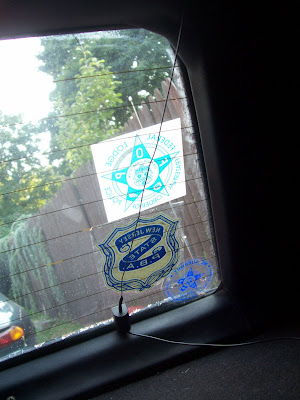
Now SIRIUS is clever. Instead of fitting the tiny radio with speakers, it transmits it's own FM signal which my car's radio picks up, just as if it was a normal radio station. In order to accomplish this, I had to fit an FEA (I've forgotten what that stands for) in the rear window of the Lincoln, facing the radio antenna.

Once I've done that, I simply tune it to the correct frequency (in this case, 103.9FM - an unused local FM bandwidth) and SIRIUS comes roaring out of my speakers instead of that local crap they euphemistically call radio.

So even with an ancient car and the technical ingenuity of a brick, I managed to update the Militant Gingermobile with the latest in satellite audio technology in less than half an hour.

And the truly incredible thing?

It actually works!