Showing posts with label satellite radio. Show all posts

Tuesday, March 11, 2008

Whatever happened to the Future of Digital Radio?

Last month, Fru Hazlitt, the Chief Executive of Gcap Media - Britain's largest commercial radio group - decided to pull the plug on Gcap's ambitious adventure into the world of Digital Radio.

It was a surprising move - since Gcap Media has been the leading commercial champion of Digital Radio since the very beginning. This has led many people to wonder: 'If Digital Audio Broadcasting (DAB) isn't the future of radio... What is?'

What is DAB all about?

The technology behind Digital Radio was invented back in the 1980s. Very simply, it offered digital broadcast of audio transmissions, as opposed to the old fashioned FM broadcasting that has given commercial radio it's voice since the 1920s.

[Militant Ginger's father pointed out that FM only came in during the 1950's. Before then, radio was broadcast exclusively on AM. Seems a radio-industry veteran like Ginger ought to have known that! - Editorial Bear.]

The advantages of Digital Radio seem obvious. With a digital signal, reception and clarity are much better - with no hiss or crackle like traditional radio. Additionally, stations can transmit on a much narrower band - meaning there's the opportunity for more radio stations to exist within the same geographical area.

But there are are two disadvantages to commercial digital radio. Firstly, it can only be picked up with a special digital radio - which is considerably more expensive than a regular FM receiver. Secondly, the costs of running a digital radio station are even higher than running an FM station - and by limiting your audience to digital-only receivers, a DAB radio station is also limiting it's revenue stream through advertising and sponsorship.

And that's what really killed Digital Radio. Despite a decade of digital broadcasting, only 9% of radio listeners have adopted digital radio in their home or car - and only 4% of British radio stations transmit on digital frequency alone.

What's the alternative?

There is a market in which a form of digital radio is proving to be astonishingly successful - but not in the limited way the European DAB market would have imagined.

In the United States, two companies are broadcasting a digital audio signal from space - and it's this fascinating technology that might well be the Future of Digital Radio.

Satellite Radio.

XM and SIRIUS are two American companies offering nothing less than 'Satellite Radio.'

Broadcast from a series of satellites orbiting the Earth, SIRIUS and XM offer digital radio signals that can be picked up anywhere in the mainland US through a dedicated SIRIUS or XM radio.

So just like DAB listeners in the UK, a special radio is required to listen to satellite radio. But why have consumers adopted XM and SIRIUS, while listeners have shunned Digital Radio in Britain?

Infrastructure

DAB stations in the UK are limited by geography, in much the same way a traditional FM radio station is. Their DAB signal is broadcast from a transmitter and can only be received within that transmitter's radius.

This presents two problems. Firstly, that digital station's audience is limited to within the transmission area - meaning a commercially-funded station is limited in the amount of advertising revenue it can collect. Secondly, the costs of transmitting a digital signal are very high - meaning the operating costs of a local Digital Radio station are actually higher than a traditional FM radio station.

Satellite Radio eliminates both of these problems with an ingenious - but fiendishly expensive - solution. Sending their transmitters into space.

Although the cost of designing, building and launching satellites is ridiculously expensive, once the satellite transmitters are up there, floating above the Earth, they can transmit hundreds of individual radio stations at very little cost and they can be heard practically anywhere in North America.

And this is where satellite radio trumps DAB. Instead of a Digital Radio group owning twenty stations, each with their own headquarters, presenters, sales teams, vehicles and transmitters, XM and SIRIUS radio can run hundreds of radio stations from a single location - dramatically reducing their overhead.

What's more, each one of those stations can be heard anywhere in the country - while DAB stations are always limited by the range of their transmitters.

Less cost. More listeners. Despite the outrageous start-up expense, it's immediately obvious that satellite radio has a much healthier business model than a DAB radio group.

But it gets better...

One of the major obstacles facing any commercial radio enterprise in the UK is the BBC - which is why satellite radio in the US jumps out of the starting-box with a good head start.

In the UK, every single television-owning household has to pay the 'Licence Fee,' which goes towards the funding of the British Broadcasting Corporation. They're a state-funded television and radio company - and a crippling rival for any commercially funded radio station.

It was the BBC's decision to adopt digital radio that gave DAB such a leg-up in the British marketplace. The BBC is not held accountable by any shareholders or advertisers - and with a whopping £4 billion annual budget, they can afford a digital adventure in a way no commercial enterprise could hope to match.

But companies like Gcap Media DID try to match the BBC - and did a sterling job in the face of overwhelming odds. But one of the reasons Gcap's digital broadcasts have failed is because they're struggling against a well-funded, commercial-free competitor that steals listeners and robs them of revenue. It's very difficult to compete.

Radio Rivals

Satellite radio, on the other hand, doesn't have the BBC breathing down it's neck. Their major competitors are the traditional FM radio stations (of which there are thousands, all across the United States.)

The satellite radio model has adapted to compete against traditional radio by offering a package that's just as attractive as what the BBC offers British listeners.

You see, since the first radio advertisement was aired in 1922, commercial radio in the USA has been driven almost exclusively by advertising revenue - which is good for the advertiser, but bad for the listener. Stations are chock-full of adverts, sponsorships, promotions and tie-ins, leaving barely enough time for an increasingly generic playlist of popular middle-of-the-road songs.

What XM and SIRIUS have done is to ignore advertising as a source of revenue almost entirely - instead charging listeners about twelve bucks a month to enjoy their satellite radio service.

So a consumer has to not only purchase a satellite radio (costing from between $39.99 to upwards of $300) but also commit themselves to a subscription. A daunting prospect, given that the UK's listeners couldn't even make the commitment of buying a digital radio.

But by offering subscribers access to hundreds of unique channels (which they can listen to anywhere in the United States) SIRIUS and XM have managed to attract almost twenty million subscribers - who can enjoy an enormous choice of music (anything from the latest pop songs to channels dedicated to bluegrass, Frank Sinatra or Elvis) with no commercials whatsoever - plus dozens of talk and sports channels (although some are subsidized by advertising revenue.)

It seems twisted at first - but then it makes a lot of sense. In the UK, DAB radio stations were asking potential listeners to shell out cash for a digital radio in order to receive the same advertising-funded radio they could enjoy for free with an FM receiver. Less than 10% of British radio listeners were willing to do that.

SIRIUS and XM made the same demand - but offered the incentive of better radio, with more choice and less commercial interuption - giving listeners a real advantage in switching to satellite. That's why satellite subscription took off, while DAB listening in the UK has never really succeeded.

So is Satellite Radio the future?

The last decade or so has seen an explosion in the audio entertainment industry.

For decades, FM radio was the only way to get a constantly updated, portable source of audio entertainment. But now, with the invention of the iPod and MP3 player, plus Internet radio and mobile phone technology that delivers music right to your handset, there are dozens of other ways to hear the music or chat you want without ever going near a radio.

But I think satellite radio has them all beat - for the next few years, in any case.

One of the reasons why satellite radio is so competitive with traditional radio - and has succeeded where DAB has failed - is because of the solid infrastructure.

The XM and SIRIUS satellites broadcast a one-way signal that can be picked up anywhere in the United States - and adding additional listeners doesn't cost the company anything. In fact, at this point in time, we're reaching the stage at which there are enough subscribers to keep satellite radio in the black - and each additional listener is pure profit.

In fifty years time, everyone in America could have a portable satellite radio with them and enjoy the same quality of signal that the early adopters do now.

There isn't really an audio entertainment medium currently going that can compete with that.

Mobile phone companies are offering Internet radio or music downloads through the cellular network - but every additional consumer eats more bandwidth, meaning cell-phone networks needs to keep building and maintaining additional transmitters to keep up with the demand. New listeners cost money.

Traditional FM stations are losing listeners to the likes of the iPod and satellite radio - and they still suffer from an audience limited by geographic area and a revenue stream dependent on the number of 'pairs of ears' they can offer advertisers.

Because of the sheer scale of the United States, DAB has never really taken off here - and I doubt it will, given the prohibitive cost-per-listener.

No, for the time being, satellite radio offers the best audio entertainment to the most people for the least cost - and as time goes on (and the enormous initial outlays involved in setting up the XM and SIRIUS satellite network are repaid) the strengths of the satellite radio concept will continue to shine.

SIRIUS Satellite Radio.

XM Satellite Radio

Wednesday, November 07, 2007

Stiletto 2 vs iPod

Find out more about Stiletto 2 - including a complete review - here.

So many people have been looking up this question, I thought I'd split my previous post into two and cut right to the chase! I've tried to consider the options and this is what I've come up with.

Cost: An iPod 'classic' will set you back $349 - twenty bucks more than the Stiletto 2. But you don't need to pay a monthly subscription to receive service (the Stiletto 2 will cost you $12.95 a month.) Bear in mind, though, that you'll have to buy content to listen to, either in the form of CD's you 'burn' through iTunes, or through iTunes itself (in which you pay for each individual song or album you buy.)

The $12.95 for a SIRIUS subscription - which delivers 130 channels of constantly live music and talk - would buy you less than fourteen songs a month via iTunes. And with the 'love' button, you can store twenty times that many songs absolutely free on your Stiletto 2, to listen to any time you want. Winner: Stiletto 2.

Looks: The Stiletto 2 is very clearly a product of the iPod generation. From the glossy black finish to the rotating media dial, the whole layout of the Stiletto 2 should feel intuitive to iPod users. The Stiletto 2 is a very attractive little device - but it's clearly riding on the iPod's coattails.

From the slick little iTouch to the elegance and simplicity of the iPod 'nano,' this is the stuff Apple do best and however groundbreaking the concept and execution of Stiletto 2 is, the physical design of the device was intentionally modeled on the iPod concepts. Winner: iPod.

Features: On the face of it, the iPod might appear to have the Stiletto 2 beat. Even the budget priced 80gb iPod 'Classic' has ten times as much storage as Stiletto 2 - and can play videos and display pictures on the tiny screen. If watching squinty versions of your favourite movies (compressed to the size of a postage stamp) is your sort of thing, the iPod is the clear winner. On the other hand, Stiletto 2 features all that live music and radio, which the iPod simply can't match. The only iPod contents you can enjoy, you have to buy and upload yourself.

There's no clear winner here - you just have to decide what it is you'll be using your handheld device for. If you're pretty sure you'll only be using it to listen to music and radio, the Stiletto 2 is the winner. If you fancy looking at pictures and watching videos - or have a music collection that takes up more than one room of your apartment - the iPod is for you. Winner: Draw.

'Cool' ness: An iPod is SO last year. What was once the must-have accessory is now utterly commonplace. The iPod 'Touch' is pretty 'cool', as is the Apple iPhone, but the recent Apple scandals (like dropping the price of the iPhone just two months after it first went on sale) has damaged Apple's 'hip' brand and made a lot of their most loyal customers look like chumps.

For the next year or so, the Stiletto 2 will certainly top the iPod in 'show off' stakes. Winner: Stiletto 2.

So the verdict is in, two to one the Stiletto 2 is a better bet this season than whatever Apple is touting from their iStore. The question is whether consumers will be brave enough to admit it.

SIRIUS is launching a pretty daring campaign by going head to head with Apple. For the last few years, no handheld music device has been taken seriously unless it has an 'i' in the name. Although there are plenty of other portable devices that play music and movies (like the Microsoft Xune) the iBrand has a stranglehold on the market.

However, the Stiletto 2 is standing out from the crowd by genuinely offering something Apple can't. Stiletto 2 features live radio - 130 channels of it. It's effortless, it's ingenious and it genuinely appeals to everybody. There's SIRIUS Channel 80 for my father, Channel 62 for my mother, my wife can get her Morrisey injection on Channel 8, my sister can stay top of the pops on Channel 1 and there's even the defining music from my brother's generation on Channel 23. And for me? A quiet evening in with the Chairman of the Board on Channel 75.

What's great about the Stiletto 2 - and head and shoulders above the iPod - is that all of this content is live. If you're listening to the Top 40 on Sirius Channel 1, you can hear, save and store the new 'Number One' the moment it's announced. It's coming at you fresh, unscripted and constantly updated in a way the iPod simply can't deliver.

Stiletto 2 is available across North America for $329.99 - and requires a monthly $12.95 subscription to listen to SIRIUS Satellite Radio.

The Skinny on the Stiletto 2

Just the other day, I was lucky enough to get my hands on a brand new SIRIUS Stiletto 2.

They've only just been released and will set you back $329 in any store you find one in (try Best Buy, Radioshack or Circuit City.)

But the question on many people's lips (well, the ones I've been boasting too, anyway) is 'Just what IS a Stiletto 2?"

Well, Stiletto 2 is a handheld, portable Satellite Radio - like an iPod thingy which picks up 130 SIRIUS radio 'channels'.

So through your headphones, you get commercial-free music (they've got stuff to suit EVERY taste, from channels dedicated to Sinatra and Springsteen to Bluegrass stations and the latest pop and rock hits) plus loads of talk, news, entertainment and the 'boring' stuff like local weather and traffic.

Normally you can only pick this stuff up if your car's got a SIRIUS radio (see me fitting one to my monstrous '86 Lincoln here) but now you can roam about to your hearts content with all of that music, sports and chat crammed into your pocket.

It's really very clever.

The Stiletto 2 comes with a pair of 'antenna headphones' which turn your head into a satellite dish, picking up the space transmissions and delivering them to a little radio the size of a mobile phone.

SIRIUS radio, wherever you go!

But that's not all it does - because otherwise it would just be a really cool, space-age version of those $5 pocket FM radios you can pick up.

The Stiletto 2 also works as an iPod style MP3 player - it's very clearly designed to take a bite out of Apple's share of this market.

You can plug Stiletto 2 into your computer and upload 2gbs of your favourite MP3 and WMA files - and then create playlists and organise them and basically do everything Apple Mac's similarly priced iPod can do - plus pick up all that lovely radio, too.

Okay, so iPods might have more storage space (some of them go as high as 160gbs) but you can expand the storage in your Stiletto 2 with a cheap microSD™ memory card - upgrading it to 8gbs and storing hundreds of hours of music.

And seriously, if your 'essential' music collection can't fit onto an 8gb memory card (that's the equivalent of 1,500 individual songs) then you need to step AWAY from the iTunes and go out and get yourself a life.

And the 130 radio stations and MP3 library crammed into that funky little device isn't the be-all and end-all of the Stiletto 2. It's got some more tricks up it's elegant black sleeve.

With the Stiletto 2, obsessive music fans can create their own music library without spending a penny on iTunes. There's this little 'love' button on the front of the Stiletto 2. If you're walking down the street, rocking to a track you like, you can give that button a tap and it'll record the song you're listening to.

Bang! One touch, one song - squirrelled away on your Stiletto's memory and accessible any time you want to listen to it, in exactly the same way as your MP3 collection. No need to find it on iTunes first, shell out $0.99 and upload it to your playlist.

Stiletto 2 lets you do this for pretty much any song you hear, on any of the 69 music channels. That means before you know it, you've got an iTunes style library of downloaded music without having gone anywhere near a PC.

Okay, it's not quite as perfect as it sounds. Some record companies don't want listeners downloading their music for free, so certain tracks are blocked. The Stiletto 2 also limits the amount of individual songs you can download, restricting you to a mere 10 hours of 'loved' songs. But, that's still around 200 songs! For free!

And as Tommy Cooper once said - Wait, there's more...

As any of you technical types will have discovered, there is one disadvantage to satellite radio. Your car's SIRIUS radio stops receiving a signal when you go into a tunnel or garage. Likewise, the Stiletto 2 can't pick up a satellite feed if you're inside a building, in the subway or even standing underneath a particularly bushy tree.

But the Stiletto 2 cleverly comes up with two different options to keep you tuned in even when you're out of the range of the SIRIUS satellite rays.

The first is really clever - a WiFi listening device.

Good old WiFi is everywhere these days. Go to your local coffee shop or MacDonalds and your wireless-equipped laptop will be able to access the Internet (without having to be plugged into anything.) Your Stiletto 2 can do exactly the same thing!

Either automatically, or with a bit of nudging, the Stiletto 2 will connect wirelessly to any WiFi network around - and you can listen to most (but not all) of the SIRIUS radio channels via the Internet. You don't need a computer, either. Just press a few buttons and you'll be able to listen to SIRIUS in any coffee shop in North America - as long as it's got one of those free WiFi networks (and no self-respecting coffee shop is without one these days.)

But if you find yourself in some obscure corner of the globe in which you are robbed of both a satellite signal and a WiFi network, all is not lost - you won't be limited to enjoying whatever MP3's you've uploaded, or listening to songs you've previously recorded off SIRIUS.

Because clever old Stiletto 2 anticipates these signal shortages - and while you're listening away in the warm sunlight (and receiving a satellite signal) the Stiletto 2 will automatically record 'radio replays.'

These are big chunks of music and talk recorded from live satellite radio. When you find yourself in obscuria, you can nip to the 'radio replay' function on Stiletto 2 and you'll be able to enjoy hours of content your sneaky Stiletto recorded earlier.

So with a satellite receiver, WiFi mode, radio replays and all that lovely MP3 storage capacity, the Stiletto 2 makes sure you always have something new to listen to.

It's pretty neat!

I think the big question on everybody's lips is:

Should I get a Stiletto 2 instead of an iPod?

Well, that's a tough question. I've tried to consider the options and this is what I've come up with.

Cost: An iPod 'classic' will set you back $349 - twenty bucks more than the Stiletto 2. But you don't need to pay a monthly subscription to receive service (the Stiletto 2 will cost you $12.95 a month.) Bear in mind, though, that you'll have to buy content to listen to, either in the form of CD's you 'burn' through iTunes, or through iTunes itself (in which you pay for each individual song or album you buy.)

The $12.95 for a SIRIUS subscription - which delivers 130 channels of constantly live music and talk - would buy you less than fourteen songs a month via iTunes. And with the 'love' button, you can store twenty times that many songs absolutely free on your Stiletto 2, to listen to any time you want. Winner: Stiletto 2.

Looks: The Stiletto 2 is very clearly a product of the iPod generation. From the glossy black finish to the rotating media dial, the whole layout of the Stiletto 2 should feel intuitive to iPod users. The Stiletto 2 is a very attractive little device - but it's clearly riding on the iPod's coattails.

From the slick little iTouch to the elegance and simplicity of the iPod 'nano,' this is the stuff Apple do best and however groundbreaking the concept and execution of Stiletto 2 is, the physical design of the device was intentionally modeled on the iPod concepts. Winner: iPod.

Features: On the face of it, the iPod might appear to have the Stiletto 2 beat. Even the budget priced 80gb iPod 'Classic' has ten times as much storage as Stiletto 2 - and can play videos and display pictures on the tiny screen. If watching squinty versions of your favourite movies (compressed to the size of a postage stamp) is your sort of thing, the iPod is the clear winner. On the other hand, Stiletto 2 features all that live music and radio, which the iPod simply can't match. The only iPod contents you can enjoy, you have to buy and upload yourself.

There's no clear winner here - you just have to decide what it is you'll be using your handheld device for. If you're pretty sure you'll only be using it to listen to music and radio, the Stiletto 2 is the winner. If you fancy looking at pictures and watching videos - or have a music collection that takes up more than one room of your apartment - the iPod is for you. Winner: Draw.

'Cool' ness: An iPod is SO last year. What was once the must-have accessory is now utterly commonplace. The iPod 'Touch' is pretty 'cool', as is the Apple iPhone, but the recent Apple scandals (like dropping the price of the iPhone just two months after it first went on sale) has damaged Apple's 'hip' brand and made a lot of their most loyal customers look like chumps.

For the next year or so, the Stiletto 2 will certainly top the iPod in 'show off' stakes. Winner: Stiletto 2.

So the verdict is in, two to one the Stiletto 2 is a better bet this season than whatever Apple is touting from their iStore. The question is whether consumers will be brave enough to admit it.

SIRIUS is launching a pretty daring campaign by going head to head with Apple. For the last few years, no handheld music device has been taken seriously unless it has an 'i' in the name. Although there are plenty of other portable devices that play music and movies (like the Microsoft Xune) the iBrand has a stranglehold on the market.

However, the Stiletto 2 is standing out from the crowd by genuinely offering something Apple can't. Stiletto 2 features live radio - 130 channels of it. It's effortless, it's ingenious and it genuinely appeals to everybody. There's SIRIUS Channel 80 for my father, Channel 62 for my mother, my wife can get her Morrisey injection on Channel 8, my sister can stay top of the pops on Channel 1 and there's even the defining music from my brother's generation on Channel 23. And for me? A quiet evening in with the Chairman of the Board on Channel 75.

What's great about the Stiletto 2 - and head and shoulders above the iPod - is that all of this content is live. If you're listening to the Top 40 on Sirius Channel 1, you can hear, save and store the new 'Number One' the moment it's announced. It's coming at you fresh, unscripted and constantly updated in a way the iPod simply can't deliver.

Stiletto 2 is available across North America for $329.99 - and requires a monthly $12.95 subscription to listen to SIRIUS Satellite Radio.

Thursday, September 06, 2007

SIRIUS and the classic car...

Have you heard of SIRIUS Satellite Radio?

If you're an American, you probably have. SIRIUS and it's rival, XM, are the two satellite radio providers for North America and both have invested heavily in convincing the American radio listener to switch from terrestrial FM stations to the wonders of satellite radio.

And to be honest, there's a lot in it for the consumer. Commercial radio is pretty awful in America. All the stations are filled with commercials, sponsorships and promotions. In order to cut costs, programming is syndicated, automated and mangled. Playlists are incredibly restrictive. Originality is out the window.
.
Satellite radio offers 100% commercial-free radio, unparalleled choice in musical styles (SIRIUS has 69 different music channels) and you can pick it up in crisp, digital quality from coast to coast thanks to transmitters hanging (or flying, in the case of the SIRIUS ones) through space.
.
The only problem is: Terrestrial radio is free. To pick up satellite radio, you need to buy an actual radio transmitter (and SIRIUS and XM radios aren't cross compatible) and a subscription to either service, paid either monthly or as a 'lifetime' subscription.

That's a choice you have to make for yourself. Personally, I'd pay $12,95 a month just so I'm spared having to listen to those bloody GIECO commercials!

In any event, once you've chosen satellite radio, it's up to you to get listening and in the case of SIRIUS, this involves buying and installing a radio.

There are handheld versions, the Stiletto range, which are as intuitive as the average iPod (and can hold as much music, plus get all the SIRIUS radio channels.) You could buy a home unit which plugs into your stereo. In most people's cases, however, the best option is a Dock & Play unit which can be retrofitted in your car.

I am now the proud owner (or borrower) of a Starmate 4 Dock & Play radio. When it came to fitting this swanky new radio in my car, I really decided to test the SIRIUS promise of a simple installation. Out of the millions of SIRIUS radios being used across North America, I imagine very few have been fitted to a car quite as old as mine.

Behold the Militant Gingermobile. 'Bertha' or 'Traveler' depending on who you talk to. An '86 Lincoln Towncar that was designed and constructed a full decade before the technology in my Starmate 4 had even been envisaged.
.
Despite the technology gap, the initial fitting of the Starmate seemed to be quite easy. The instructions helped me fit the radio 'dock' to one of my air-vents and the wires neatly slipped into the dash board the same way loose change does.
.

In order to pick up the SIRIUS signal, I needed to fit an external antenna to my car. This little magnetic gidget ideally slaps to a big piece of sheet metal (of which the Lincoln has about 4,400lbs) and turns it into a gigantic antenna. The instructions say it has to go onto the roof.

This presented a problem. Despite being so enormous, my Lincoln Town Car has no bare metal on it's roof at all. The entire thing is covered in black vinyl - thick enough to stop the magnet from sticking to the car.

Fortunately the instructions give alternative options for pick up trucks and convertibles, so I was able to fathom a solution to my problem. Just as you'd have to do with a rag-top car, I stuck my antenna onto the boot of the Lincoln.
.

The antenna wire from the dashboard radio trailed easily along the car and I was able to slip it under the edges of the carpet, hiding the wire from view and preventing any snagging. Then it was simple to pop it through the firewall - although I had to physically clamber into the boot to accomplish this, always worried that the lid would shut and trap me inside!
.


Then I just snaked the cable around the hinge, attached antenna to radio and the job was done neatly and simply. It took about ten minutes and half of that was the commute from one end of my enormous car to the other.

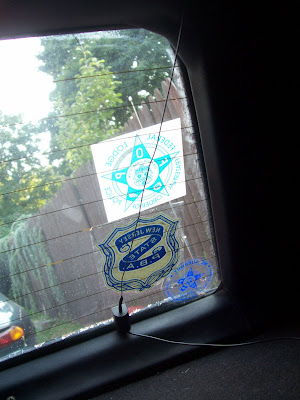
Now SIRIUS is clever. Instead of fitting the tiny radio with speakers, it transmits it's own FM signal which my car's radio picks up, just as if it was a normal radio station. In order to accomplish this, I had to fit an FEA (I've forgotten what that stands for) in the rear window of the Lincoln, facing the radio antenna.

Once I've done that, I simply tune it to the correct frequency (in this case, 103.9FM - an unused local FM bandwidth) and SIRIUS comes roaring out of my speakers instead of that local crap they euphemistically call radio.

So even with an ancient car and the technical ingenuity of a brick, I managed to update the Militant Gingermobile with the latest in satellite audio technology in less than half an hour.

And the truly incredible thing?

It actually works!