Showing posts with label ethanol. Show all posts

Thursday, June 19, 2008

The New Jersey Gas Paradox

New Jersey has some of the lowest petrol prices in the country - still a hair's breadth under $4 a gallon while the rest of the country heads towards $5. What New Jersey doesn't have, however, is a single gas pump selling Ethanol.

Now I've mentioned several times that Ethanol is not the answer to America's gas crisis - but it might well be the solution to my own personal gas crisis (the five litre 'gas crisis' I've got parked on the driveway.) Driving a Firebird 'hot rod' would be a lot more affordable if I could fill up on the $2.75 a gallon ethanol for sale in neighbouring New York and Pennsylvania.

Which I can't, since my Trans Am can travel about 175 miles on a single tank of gas, which is barely enough to drive me to the nearest Ethanol pump and back.

It does make me wonder why New Jersey hasn't embraced Ethanol. Da Doity Joiz, as some people call it, is one of (occasionally the) richest state in America and liberal enough to embrace most tree hugging 'hippy crap' people suggest.

I'm sure such misguided people (like me) would make Ethanol a roaring business in this state, as long as the costs remained cheaper than petrol. But, no.

Nobody's got the testicular fortitude to give that game a try and as such, I'm left pretty much like the entire United States - a slave to fossil fuels.

Wednesday, May 07, 2008

The Fuel Crisis and Firebirds...

Petrol crept up another 3 cents at my local Exxon station last night, which increased the heat on my gas-guzzling '85 Firebird.
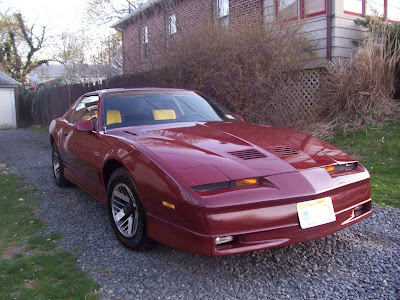
But actually, my morning fill-up brought cheerful news. After cleaning the carbs out this weekend, along with cleaning the air filter, I'd managed to squeeze a whole extra mile-and-a-bit a gallon out of the old girl. I've added some additive to her fuel as well, which should hopefully see things improve even further.

But it made me think even harder about the gas crisis and what's to be done about it. I went online to find out about ethanol and how realistic it would be to convert my Firebird to run off E85 (the 85% ethanol fuel mixture that's the highest percentage allowed by US law.)

Well, the answer is - Not Very (realistic, that is.)

Only because New Jersey does not have a single ethanol pump in the entire state. There are 6 within 200 miles of here, but they're all in New York or Pennsylvania. Considering my 14 gallon tank only takes me 200 miles, it's not practical to consider switching to moonshine quite yet since I'd run out of juice driving there or back.

But there was good news!

Firstly, that ethanol is selling for about $1 less than regular gas, so if I was able to make the switch (and there was a source of fuel near me) it would actually prove to be cost effective. Previously, because of the cost of corn, the subsidies to farmers and the tariffs of imported ethanol, E85 ironically cost the same (or more) than regular gas. Now OPEC's got too greedy and priced themselves above the alternative.

Secondly - there appear to be no practical issues about switching my Firebird to ethanol.

Firebird Fuel Frenzy

Ethanol works in pretty much the same way as petrol - it's injected into the pistons and ignited with a spark, turning the crank and powering your wheels.

The only major difference is that the mixture of air/fuel needs to be richer and the timing needs to be adjusted, so the fuel ignites slightly earlier. With fuel-injected cars, making the 'shift' to Ethanol can be as simple as just filling your tank (since even my '86 Lincoln Town Car had an on board computer which could vary the fuel mixture.)

My Firebird gets it's fuel from duel-barrel Holley carburetors, though, which is a mechanical bit of kit that can't adjust itself to handle the new fuel. In order to switch to ethanol, the carb's jets need to be increased by between 25/40% and the automatic choke adjusted to increase the mixture. Basically, you need a new set of carbs - which would set you back about $500.

But that's it!

Horror stories about ethanol eating rubber hoses and gaskets are increasingly being debunked, as more and more converted cars run for hundreds of thousands of miles without running into problems. In actual fact, because of the gas crisis of the mid seventies, many car manufacturers have been producing cars robust enough to handle the switch to ethanol as early as the 1980's (just in case it ever happened.)

But that brings us back to the original problem - where the hell am I going to find fourteen gallons of ethanol every time I need to drive somewhere?

The Ethanol Enigma

My brother's a very smart chap and has been educating me on the logistics of ethanol and it's production, plus how it (unfavourably) stacks up against biodiesel.

For America, ethanol is not the answer. Even if all our corn got diverted to fuel production, we could only domestically produce about 20% of America's demand for gas.

Plus, that would send food prices rocketing. Corn on the cob would be a luxury item.

However, just because ethanol doesn't solve America's gas crisis, it doesn't mean it won't solve mine! My brother caught my imagination by mentioning the idea of home fuel production - and how wouldn't it be wonderful if farmers and truckers could 'brew their own' biodiesel or ethanol at home.

Screw the farmers. What about me?

Home Brew

Well, amazingly enough, the answer to personal fuel-production already exists - and it's hitting the open market this month.

Fascinating website Change2E85.com is unveiling the EFuel100 Micro Fueler.

Basically, it's a backyard still that makes fuel instead of whiskey. Using sugar or animal feed (once it's broken down with yeast) the EFuel100 Micro Fueler can produce ethanol for as little as a dollar a gallon. What's more, the unit costs $10,000 (which might be reduced if the government gives tax credits) and can sit in your back yard right next to your garage.

Now it's not perfect. The machine runs off sugar and at the moment, the American government slaps a huge tariff on imported sugar, making it cost about 20 cents a pound wholesale. Cost-effective fuel would only be possible if sugar was sold 'at cost' instead of safe-guarding the subsidized American farmer.

Also, you need to get a licence for a still like this (in case you turn to moon-shining) and only property owners are allowed to have one.

But given the right circumstances, there is nothing to stop somebody buying a still and producing their own ethanol fuel - pretty much making themselves independent of foreign oil and the greedy oil companies.

The Future

It's fair to assume that the next generation of passenger vehicles will be powered by electricity and oil itself will be a dying industry. But for classic car enthusiasts, or gun-toting survivalists, the thought of producing your own fuel sounds very appealing.

Unfortunately, with a baby on the way and other expensive realities to consider, I'm not really in a position to drop ten grand on a 'home stil'l to bio-fuel my Firebird. But it's nice to know that the technology already exists to lift the yoke of the oil companies.

Already, more and more people are striking out for energy independence. Maybe, in the not-too distant future, I can be one of them.

If you're interested in the realities of alternative fuel, please go and check out Change2E85.com to find out how YOU can make the switch!

Tuesday, April 22, 2008

Bio-Fuel Balls Up

When I first moved to America - which was only ten months ago - corn-on-the-cob was available from our local supermarket for 19 cents an ear.

These days, it's approaching European prices - $1.99 for two ears.

Part of this is because corn's not in season at the moment. Another major influence has been the big push into the production of biofuels.

I've written about it before. Most biofuels aren't really a viable replacement for petrol yet - especially the ones derived from corn. For a start, it takes just as much energy to produce biofuel from corn as the fuel actually generates. If the original source of energy is coal, oil or petrol-based, a gallon of 'clean' ethanol has actually generated as much greenhouse gas as a gallon of regular gasoline.

Secondly - wasting corn in the production of an inefficient petrol substitute removes it from the food chain, reducing supplies of a staple feed crop. This dramatically increases the price of corn-based produce in the shops. That effects everything from my corn-on-the-cob to all the supermarket foods laden with high fructose corn syrup (which includes everything from extended-life bread to 'all natural' soda drinks.)

This has effected all of us - but my expensive ears of corn are nothing compared to the effects food-inflation is having on the rest of the world. All across the globe, the very poor are finding it increasingly difficult to feed themselves as they face what the World Nation's Food Program call a 'food price tsunami.'

It's about time we stopped blithely following the climate-change trend and actually looked sternly and objectively at the whole picture.

Most biofuels are not efficient. More research has to be done to produce an efficient and sustainable alternative to gasoline (my brother mentioned that, in the future, genetically modified enzymes could be used to turn seaweed into fuel.)

Until a decent alternative has been found, we should stop wasting vast amounts of money (and food crop) on producing overpriced ethanol, which does nothing to protect the environment.

There are entirely viable, clean and efficient energy solutions out there. It just seems that nobody's willing to invest the time researching them - especially not when a short term 'solution' like corn-based biofuel is making us all feel like we're doing something positive to prevent climate change.

Really, all that's doing is directing money into the pockets of farmers and politicians who are more interested in making a quick profit than actually doing anything constructive to save the environment.

Monday, March 10, 2008

The Great American Gas Swindle Revisited

I had another rather grumpy commenter drop a line on this vintage posting: The Great American Gas Swindle.

Unfortunately, he hadn't read the follow-up, Taking a Spin in the No-Fact Zone, which addressed the issue he and another commenter had raised regarding some of the facts [All of the facts, actually - Editorial Bear] I'd mentioned.

The issue they were discussing was the difference between European and American petrol.

I had quite reasonably assumed (based on the numbers on the pumps and a misleading Wikipedia entry) that the gasoline sold in America was of an inferior 'Octane Rating' than the petrol sold in the UK and mainland Europe.

Specifically that American gas is sold in Regular (87 Octane) Premium (89 Octane) and Super (91 Octane) varieties - all of which seem inferior to European petrol, which is sold at 94 Octane (Unleaded) or 98 Octane (Super Unleaded.)

The 'Octane' rating references the 'knock resistance' of an engine, or the likelyhood of 'Auto Ignition' which could cause 'knocking' or 'pinking.' That's the rattle in the engine that indicates the fuel is igniting early and causing your pistons to fire out of sequence (damaging your engine.)

Based on my previous information, it's very simple to assume that American petrol had a lower Octane rating (and was of inferior quality) to European fuel.

However, I have been informed that America and Europe have different ratings systems to determine the Octane Rating of their fuel. The Europeans (and most of the rest of the world) use the Research Octane Number (RON) to determine the Octane Rating.

The Americans and Canadians apparently use a measuring system called Motor Octane Number (MON) or the aviation lean octane rating - which is a similar, but more stringent test using pre-warmed fuel and variable ignition times to deliver an accurate Octane rating based on more demanding criteria.

Because the MON test is 'harder,' the Octane Ratings derived that way tend to be about 4 or 5 points lower than the equivalent European RON tests. Therefore, 89 Octane American fuel (sold as 'Premium') would actually be equivalent to regular 94 Octane Unleaded sold from European pumps.

So when it comes down to it, European and American fuel is actually pretty much the same stuff... Or is it?

There's one more important factor to consider. Across much of the United States (mandated by law in some States) the oil-based fuel sold in petrol stations is actually mixed with 10% corn-based ethanol.

This increasingly common trend is intended to help reduce America's reliance on foreign oil - and the percentage of ethanol mixed in with regular petrol will only increase as technology helps close the net energy unbalance of producing corn-based fuel.

One thing to remember about corn-ethanol based fuels is that they're about 35% less efficient than regular petroleum. Therefore, even the 10% mix in American petrol is enough to reduce your overall fuel consumption.

So while I might have been wrong about the RON and MON ratings, it's still worth remembering that what goes into your tank in America still won't get you as far as it will in Europe (and that's ignoring that fact that your American car only does 15mpg!)