
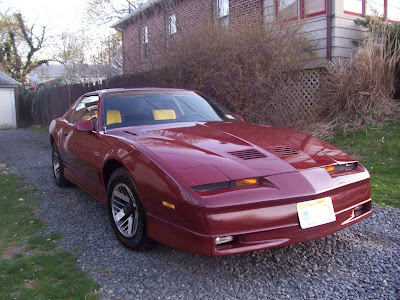
 But actually, my morning fill-up brought cheerful news. After cleaning the carbs out this weekend, along with cleaning the air filter, I'd managed to squeeze a whole extra mile-and-a-bit a gallon out of the old girl. I've added some additive to her fuel as well, which should hopefully see things improve even further.
But it made me think even harder about the gas crisis and what's to be done about it. I went online to find out about ethanol and how realistic it would be to convert my Firebird to run off E85 (the 85% ethanol fuel mixture that's the highest percentage allowed by US law.)
Well, the answer is - Not Very (realistic, that is.)
Only because New Jersey does not have a single ethanol pump in the entire state. There are 6 within 200 miles of here, but they're all in New York or Pennsylvania. Considering my 14 gallon tank only takes me 200 miles, it's not practical to consider switching to moonshine quite yet since I'd run out of juice driving there or back.
But there was good news!
Firstly, that ethanol is selling for about $1 less than regular gas, so if I was able to make the switch (and there was a source of fuel near me) it would actually prove to be cost effective. Previously, because of the cost of corn, the subsidies to farmers and the tariffs of imported ethanol, E85 ironically cost the same (or more) than regular gas. Now OPEC's got too greedy and priced themselves above the alternative.
Secondly - there appear to be no practical issues about switching my Firebird to ethanol.
Firebird Fuel Frenzy
Ethanol works in pretty much the same way as petrol - it's injected into the pistons and ignited with a spark, turning the crank and powering your wheels.
The only major difference is that the mixture of air/fuel needs to be richer and the timing needs to be adjusted, so the fuel ignites slightly earlier. With fuel-injected cars, making the 'shift' to Ethanol can be as simple as just filling your tank (since even my '86 Lincoln Town Car had an on board computer which could vary the fuel mixture.)
 My Firebird gets it's fuel from duel-barrel Holley carburetors, though, which is a mechanical bit of kit that can't adjust itself to handle the new fuel. In order to switch to ethanol, the carb's jets need to be increased by between 25/40% and the automatic choke adjusted to increase the mixture. Basically, you need a new set of carbs - which would set you back about $500.
But that's it!
Horror stories about ethanol eating rubber hoses and gaskets are increasingly being debunked, as more and more converted cars run for hundreds of thousands of miles without running into problems. In actual fact, because of the gas crisis of the mid seventies, many car manufacturers have been producing cars robust enough to handle the switch to ethanol as early as the 1980's (just in case it ever happened.)
But that brings us back to the original problem - where the hell am I going to find fourteen gallons of ethanol every time I need to drive somewhere?
The Ethanol Enigma
My brother's a very smart chap and has been educating me on the logistics of ethanol and it's production, plus how it (unfavourably) stacks up against biodiesel.
 For America, ethanol is not the answer. Even if all our corn got diverted to fuel production, we could only domestically produce about 20% of America's demand for gas.
Plus, that would send food prices rocketing. Corn on the cob would be a luxury item.
However, just because ethanol doesn't solve America's gas crisis, it doesn't mean it won't solve mine! My brother caught my imagination by mentioning the idea of home fuel production - and how wouldn't it be wonderful if farmers and truckers could 'brew their own' biodiesel or ethanol at home.
Screw the farmers. What about me?
Home Brew
Well, amazingly enough, the answer to personal fuel-production already exists - and it's hitting the open market this month.
 Fascinating website Change2E85.com is unveiling the EFuel100 Micro Fueler.
Basically, it's a backyard still that makes fuel instead of whiskey. Using sugar or animal feed (once it's broken down with yeast) the EFuel100 Micro Fueler can produce ethanol for as little as a dollar a gallon. What's more, the unit costs $10,000 (which might be reduced if the government gives tax credits) and can sit in your back yard right next to your garage.
Now it's not perfect. The machine runs off sugar and at the moment, the American government slaps a huge tariff on imported sugar, making it cost about 20 cents a pound wholesale. Cost-effective fuel would only be possible if sugar was sold 'at cost' instead of safe-guarding the subsidized American farmer.
Also, you need to get a licence for a still like this (in case you turn to moon-shining) and only property owners are allowed to have one.
But given the right circumstances, there is nothing to stop somebody buying a still and producing their own ethanol fuel - pretty much making themselves independent of foreign oil and the greedy oil companies.
The Future
It's fair to assume that the next generation of passenger vehicles will be powered by electricity and oil itself will be a dying industry. But for classic car enthusiasts, or gun-toting survivalists, the thought of producing your own fuel sounds very appealing.
Unfortunately, with a baby on the way and other expensive realities to consider, I'm not really in a position to drop ten grand on a 'home stil'l to bio-fuel my Firebird. But it's nice to know that the technology already exists to lift the yoke of the oil companies.
 Already, more and more people are striking out for energy independence. Maybe, in the not-too distant future, I can be one of them.
If you're interested in the realities of alternative fuel, please go and check out Change2E85.com to find out how YOU can make the switch!


