Showing posts with label debate. Show all posts

Monday, February 07, 2011

The Great Debate: "Is it appropriate for the United States Pledge of Allegiance to contain the words 'under God' in it?"

Today is the first of (hopefully) a series of cross-blog debates with conservative blogger Mike Waters; who enjoys the challenge of a gentlemanly discussion. To kick things off, we started with the question of whether or not 'under God' should be included in the Pledge of Allegiance. He argues 'yes,' whereas as an atheist, I firmly believe that God should stay out of my business (after all, I stay out of his.)

Go and read Mike's opinion over on his blog; and be sure to comment on what you read!

In the mean time, here's my two cents:


"Is it appropriate for the United States Pledge of Allegiance to contain the words 'under God' in it?"

When an Atheist wades into this issue, people roll their eyes.

“Here it comes! More crap from some idiot claiming two words inhibit his ‘freedoms’.”

And honestly, that's how I felt until recently! Even though I was atheist, ‘under God’ seemed so utterly inconsequential, the phrase had never bothered me before. It was just tradition, right?

But that was because I’d never been asked to recite the Pledge of Allegiance before.

The day I became an American, I stood up and realized these words meant something.

The Pledge of Allegiance was as significant to me as my marriage vows, which meant the words ‘under God’ presented a problem: because God had nothing to do with my allegiance to America.

And while 90% of Americans are Christian, it’s wrong that the rest should be required to pledge loyalty to something we don’t believe in; especially when it’s attached to something we do so passionately believe in (i.e. our allegiance to the United States.)

The founding fathers agreed. Their First Amendment reads: “…make no law respecting an establishment of religion.”

By including the words ‘under God’ in the pledge, it ‘establishes’ a single, monotheistic religion (one God, instead of none, or many) that contradicts the beliefs of atheists, Hindus and many others.

Conservatives argue: “This country was founded on Christian principles”, but the founding fathers, despite many being devout Christians, separated Church and State from the very beginning.

Benjamin Franklin even edited Thomas Jefferson’s first draft of the Declaration of Independence to replace ‘sacred rights’ with ‘inalienable rights’ because he didn’t want people thinking that a religious deity granted these rights.

Need more proof? The 1794 Treaty of Tripoli, made law by many of the founding fathers, opened: “The Government of the United States of America is not, in any sense, founded on the Christian religion.”

But why, if the founding fathers separated church and state, are the words ‘under God’ included in the pledge at all?

Well, they had nothing to do with it. The pledge was actually written in 1894, by a Baptist minister called Francis Bellamy.

You might think: “If he was a Baptist minister, no wonder he included the words ‘under God.”

But you’d be wrong.

Because Bellamy understood the Constitution, and despite his religious beliefs, knew it would be unconstitutional to include God in the pledge.

In fact, it wasn’t until 1954, during the height of McCarthyism, that religious extremists campaigned to have ‘under God’ added. They argued that communism was defined by atheism – religion being the ‘opiate of the masses.’ To establish America’s differences more firmly, they petitioned Eisenhower to include the words ‘under God’ in the pledge (words possibly used by Abraham Lincoln during the Gettysburg Address, although many contemporary transcripts don’t include them.)

It was paranoia and persecution that forced congress to add ‘under God’ to the pledge; despite it being in opposition not just to the intentions of the founding fathers, but the man who wrote the pledge itself.

Which makes the question no longer: “Should the words ‘under God’ be removed from the pledge,” but “should they have ever been included in the first place?”

To which the answer – whether you’re a Christian or not – is a resolute, resounding: “No!”

Wednesday, October 08, 2008

The Debate

Last night's Presidential Debate in Nashville is being hotly discussed.

Before other people's opinions swayed mine, I wanted to get down what I thought of the debate - and who 'won.'

Both candidates were their normal, professional selves. Obama, of course, came across better. He's tall, with good posture and a clear voice. McCain, with his hunched shoulders and mumbled voice, looked like a comedian about to deliver a zinger of a punchline.

That being said, the substance of what McCain was saying outweighed his lack of style. for example, when he suggested renegotiating all the bad mortgages the treasury has bought, adjusting them to the new house values (and removing negative equity) I thought he'd landed an election winner.

Interpreting the facts through all the rhetoric is difficult. Obama's version of the events leading up the demise of Freddie Mac and Frannie Mae was fictitious. Similarly, McCain was wildly misleading with his promise of tax-cuts across the board (they'd be negligible unless you were very rich.)

In the end, though, McCain delivered the message he needed to and avoided the jabs Obama sent his way. But while the Republican candidate did well, I don't think it'll be enough to sway the vote in his favour.

Friday, October 03, 2008

The Vice Presidential Debate

Uniquely, last night's Vice Presidential Debate actually got more attention than the previous Presidential Debate. Apparently, America is far more interested in seeing Sarah Palin battle it out with Joe Biden than McCain and Obama bat back and forth.

Most people were expecting a bloodbath. After her appalling interview with Katie Couric, many had dismissed Sarah Palin as the fluffy little Hockey Mom - and she was going toe-to-toe with Washington veteran Joe Biden - a man who first entered the senate when Palin was just six years old.

In the end, she surprised everybody. Right from the moment she shook Biden's hand - and asked him sweetly "CanI call you Joe?" - she took control and the following debate showed her handling herself admirably.

Now the dust has settled, the media has reached a consensus that Joe Biden 'won' the debate. He did do very well - He reined in that big mouth of his, delivered concise, carefully worded responses and treated Palin like a true gentleman - anxious not to appear to be bullying her.

That being said, I think Republicans will be very happy with the way 'their girl' did. She injected folksy humor and cheery anecdotes into her fluent answers - and delivered them all with a confidence and charm that the audience appreciated. She even winked at the camera at one point.

Personally, I think she laid the 'small town Mom' shtick on a bit too thick - but certainly exceeded my expectations.

Say what you want, but this lipstick wearing pit bull is not to be underestimated.

Monday, February 11, 2008

Whatever happened to the facts?

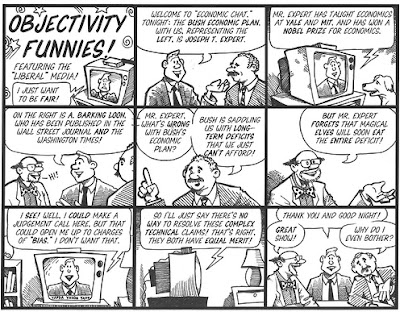
I realise I've been ragging on conservatives for quite a while - but the problem is they drive me crazy! Especially trying to debate something with one.

Because conservative logic is blissfully free of fact. Opinions and decisions are not reached through an objective appraisal of the evidence, but through sheer, pig-ignorant gut feeling. "This is the way I feel," a conservative will argue, "and nothing you tell me or show me will make me feel any different."

It's a condition comedian Stephen Colbert characterised as 'Truthiness.' "We're not talking about truth," he explained, "we're talking about something that seems like truth—the truth we want to exist."

"It used to be, everyone was entitled to their own opinion, but not their own facts," he continues, "but that's not the case anymore."

Colbert managed to hit the nail right on the head with his definition of the word 'truthiness.' Because we live in a world now that's moving further and further away from rationality, straight into the lap of blissful ignorance.

And there, facts are totally redundant.

A conservative doesn't base his or her opinions on facts. Instead, they're based on a more nourishing mixture of gut feeling and assumptions. Assumption always comes before fact - whereas a rational person examines the facts first and makes assumptions based on them afterwards.

Take creationism, for example. A creationist makes the assumption that the Bible contains an 100% accurate account of the creation of the world - 7,000 years ago when God made Adam from the clay of the earth and Eve from one of his ribs. He examines the evidence afterwards and interprets it in a way that will match his assumption.

A rational person, on the other hand, examines the evidence first and uses that as a basis for his assumptions. Learning that every tree grows a 'ring' during each year of it's life, he could cut down the oldest tree in the world, count the rings and assume (based on the facts) that the world is 4,000 years old (the age of the oldest tree on earth.) Or he could learn that there's a new layer of ice grown in the North Pole every year, so he could drill through the ice and count the layers to discover that the 'world' (or, at least, ice) was 420,000 years old. Similarly, examining geological evidence suggests the world is half a billion years old. All assumptions are based on physical evidence.

That same physical evidence is open to interpretation - which means a rational person might come to one conclusion, but be forced to change their mind should further evidence disprove their original hypothosis. The problem with conservative is that their assumptions are set in stone - often before they've even examined the facts.

Once those assumptions have been made, a true conservative is incapable of changing their mind - no matter what the 'facts' say. That's my major problem with them.

You can't debate with somebody who's incapable of changing their mind. You might as well argue with a brick wall.