
Saturday, December 30, 2006


Prejudice against Redheads: Ginger is the new Black
The actress is Catherine Tate, currently a comic sensation in Britain and star of the latest Doctor Who Christmas special. Which will unfortuntely age the thing instantly, just like old 60's show when they have topical and contemporary 'guest stars' in them that none of us can remember now.
But Catherine Tate is destined to be this generation's Harry Enfield so good for her.
Thursday, December 28, 2006
Back on the Bootleg...
 Writing requires momentum.
I think that's one thing I learned during Nanowrimo. Once you've got the momentum going and you're churning out the words, it's very easy to 'get into the zone' and continue writing. I guess that's why successful writers are so disciplined and make themselves write every single day.
When Nanowrimo finished and I beat my target, I understandably took a break from writing. But the planned few days rest has so far been over four weeks. It wasn't until today that I finally started writing again. And it was tough.
I wrote 1,600 words or so - my daily target while I was on Nanowrimo. But it was like getting blood out of a stone.
The longer you go without writing, the less your characters talk to you. The harder it is to overcome the major cause of writer's block, not feeling 'in the zone.'
Real writers - the prolific ones like Stephen King and Jeffrey Archer - realise that writing is 'work' and go to it like a day job. And I think that routine is important, otherwise you drop out of your groove and can't get back into it.
So now I've picked up the baton again, I'm going to keep writing and wrap up The Bootleg Boys as quickly as possible. It's a fun, riotous story and I'm enjoying writing it, but the end is in sight and that will be an achievement.
The continued story will get posted on Bootleg Boys tomorrow, all things working out. Until then, I'm off to dream of big sports cars and lorries full of lager.
Wednesday, December 27, 2006
The Ultimate Martini Cocktail: The Instant Martini: The Wintini!
And following firmly in Ian Fleming's footsteps, I know a lot about Martinis.

The other day, some cocky kid (I know he was cocky, he called me 'Ginge') challenged me to 'flair' a bottle of champagne. Which I can't do, because I'm not one of these TGI Friday barmen who can spin bottles around.
I'm a 'mixologist.'
A mixologist creates drinks. Flairing bottles is all fine and dandy (okay, it's a very cool art and I'm jealous of it) but when it comes to bartending, the flair is the icing on the cake. It's just 'flair' as they say. You can spin as many bottles as you like, but even if you impeccably serve up coffee syrup with tomato juice, it's going to taste horrible.
No, the real artists behind cocktails are the mixologists. They're the ones who, back in the days of prohibition, managed to mix fruit juice and soda into the cheapest bathtub gin to make it drinkable.
Bartenders are cooks. Mixologists are chefs.
And at the height of the mixologist's art is the Martini.
The Martini is truly a wonderful creation. It's the simplest, yet most complex of drinks. And, like so many things, I only truly understood it when I went to America.
It was called The Tar Bar and the guy who ran it was called Vincent, and he had an entire back room dedicated to Frank Sinatra. Located on the Upper East Side, it was the first bar I ever went to in America and it sticks in my memory like the Tartini he served stuck in my gullet.
That was the night I discovered what a REAL martini tasted like - because until then, I'd never had one. Oh, sure, you could ask for a martini in England, but unless you were at the Ritz, you'd get a lukewarm 30ml serving of Vermouth.
No, the first time I had a real Martini was in America. And in addition to learning about the secret of a proper Martini, I learned the essential rule when dealing with this suave beverage. Three is enough. Any more than that and the Martini takes control.
I learnt that the hard way, when I ended up catching the train to Hoboken instead of the homebound LIRR to Huntington. (In retrospect, I think I ended up in Hauppague, but it's my word against the rest of the world's.)
Anyway. Ever since then, I have been a real fan of the martini. And not just because of the James Bond reference (although that's why I'd been why I'd been ordering 30ml shots of Vermouth in dodgy Welsh pubs.) I loved the Martini because it was such a sublime, gorgeous drink.
So finally, after years of enjoying them, I have finally decided to unleash my own martini on the world.
I feel qualified to because I've drunk as many martinis as anybody... Well, except Faye Dunaway. And there are a million ways of combining gin/vodka and vermouth to create an exclusive drink. Go to any bar in America and ask for the 'house' Martini and you'll get a different version.
I invented this one. And it's good:
The Wintini - The Instant Martini.
I call it the Instant Martini, because there's no need for a cocktail shaker or ice cubes. This is a martini in it's purest sense. And since I invented it here in Winchester, why not call it the Wintini?
You will need:

A bottle of good quality Vodka. I recommend Stolichnaya, which is what James Bond was partial to. A grain based vodka, made in Russia, it's 40% a.b.v. and smooth as Roger Moore in a blender.
A bottle of Extra Dry Vermouth. I'd recommend Noilly Prat (that's Noy-ee PraT) since it's probably the finest vermouth going. Speaking of which, how the hell do Vermouth manufacturers keep in business? I've been making martinis for years and barely made a dent in my bottle. It's like stones ginger wine. You buy one bottle and it sits in your pantry for the next twenty years gathering dust. I'd wonder why anybody needs a new one - but apparently they keep flying off the shelves at Sainsburys.
Green Olives. Because when it comes to olives, I believe in apartheid.
Martini Glasses. Chilled.
In order to make the Wintini, you need to first make sure the vodka is good and frozen.
At 40% a.b.v., the temperature of your freezer won't freeze your vodka. Ideally, it will turn it into a gloopy syrup. At best, it will turn it into a slushy mush. This is the ideal temperature of a Martini and normally Martinis are shaken (over ice) or stirred (over ice) to get it to freezing temperature. The secret of the Wintini - why it's an instant Martini - is that the vodka comes direct from the fridge. It's not diluted in any way, but ice cold, the way a Martini should be.
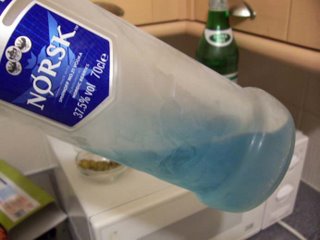
Preparing the glasses: Vermouth the is the key to a Martini. Some people suggest a light spray of vermouth over the top of the glasses. Some mixologists give a nod to a picture of the inventor of vermouth. The secret, in any way, is the bare minimum of vermouth.
What they never learned in England, but is standard practice in America, is the swish and slosh. Pouring a measure of vermouth into the glass, swilling it around and then pouring it out.

That way, the glass has a thin lining of vermouth.
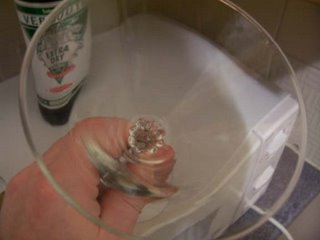
Once each glass is prepared, simply add the frozen vodka. If it's cold enough, it might be lumpy... Give the bottle a shake and then pour the frozen nectar into the glass.
Garnish with four olives and there you go. The Wintini.
No cocktail shaker or mixing jug needed. An Instant Martini.
Monday, December 25, 2006
How to become a Radio Presenter Part 1... Interview with Paul Orr.
 My post on How to Become a Voice Over Artist inspired a couple of questions on how to actually make it as a radio presenter. Radio is presently a blossoming industry and hungry for new talent, but just like becoming a commercial Voice Over, it's a competitive industry.
I have only had a very brief flirtation with radio presenting, as Rolski on the Road for 107.2 Win FM. So in order to get under the skin of the radio industry, I've been lucky enough to chat to a few radio presenters and see what their stories are.
I start off with Paul Orr, who presents the breakfast show on 106.5 Sunny FM in East Texas. Aside from being a great presenter, Paul Orr is also a great Voice Over artist for both radio and TV and his website is a brilliant example of the sort of thing any aspiring voice over artist should have.
Without further ado, my interview with Paul. My questions in bold, his answers in italic.
How long have you been a radio presenter?
Wow. You guys say "presenter". That's cool. We say announcer, jock, on-air talent or just talent or dee-jay (but I guess dee-jay is old school speak, now). I've been a radio presenter since 1980ish. My family owned an AM station in West Texas and I got my start while still in Junior High School. I was really bad - good thing my dad owned the joint.
Could you give us a brief rundown of your career?
My career has led me from Texas (Dallas, Houston and other smaller cities) over to Florida - and lots of places between. I've worked in many different formats but was most successful in the Country format which is very popular in the US.
What ambitions do you have for the future?
I'm excited about a great deal in the future. I think the possibilities for building Internet stations for retail and churches are unlimited. I love radio and enjoy being on the air. I am most excited about voice over work. I'd like to eventually work from home providing imaging and commercials. Also, Pamela Anderson is single again and have ambitions about her. ;)
When did you first get into radio presenting?
My father was the General Manager of a station when I was born and I grew up in the business. I consider myself very, very lucky for that.
Did you always want to get into radio or did you only become a presenter when the career in taxidermy didn't pan out?
Yep, this is what I always wanted to do. We're were driving through Dallas, Texas on vacation listening to 97.1 KEGL (God rest its soul) and they kicked off a 40 Minute, Non-Stop Eagle Free Flight complete with a jet swoosh over the intro of the song (Donny Iris, Love is Like a Rock) and I was hooked.
How exactly did you get your first job?
Fact, if you find an excuse to hang out at a radio station long enough - you will land a very low-paying entry level position, eventually.
Did you send in a showreel?
Showreels don't help you get your first position. They can help you once you are accomplished. In the beginning, you must show that you have the passion and desire. Get to know somebody, anybody that works at a radio station and start working then.
Did you know anybody in the business first?
Absolutely.
What do you think made you stand out from the clamouring crowd?
Eventually, they're going to need somebody at a station, you just have to make sure you are standing there when that time comes.
What's it actually like being a presenter?
It's great. In some ways, it's like having a small dose of celebrity. Some people recognize you (more so now with the web).
What's your routine like?
My day starts early. I'm in at 6 am.
What are the challenges?
We don't have as many people as we used to and that's good and bad.
Surely you must have days like the rest of us, when you hate your job.
On days when we're over-worked or stressed. What is it that makes you feel like that? Egos, lack of proper equipment, too many meetings.
What makes you have a GREAT day at work?
Working on successful promotion or campaign. Doing a really successful remote broadcast. Helping to bring in new customers and listeners with good commercials and programming.
What tips would you have for anybody trying to get into the presenting business?
Hang Around! Take out the trash, wash a presenters car, do whatever you have to do to get to know the folks at the station. Have a great attitude and be willing to do whatever it takes to get in...it will be worth it.
Thanks, Paul, for your fascinating insights into the radio biz. And don't forget to check out Paul's show, which is on from midday in the good ol' United Kingdom and you can listen to it online.
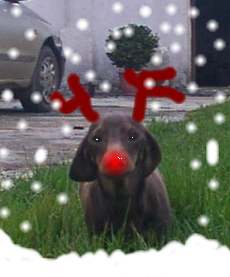
Merry Christmas!

But the original is still the best...
Thursday, December 21, 2006
Who the hell is this Conrad bloke?
 No need to get jealous and tear up your copy of Writer's News. The name Conrad has more to do with Heart of Darkness than the boyfriend of the lovely Sarah Bailey.
Instead, the girl who broke hearts in the heart of darkness is back in civilisation - presumably doing the same thing.
She's bright and brilliant and you'll find her here.
The RACC: Swearing on the Radio
 What with the popularity of downloading porn from the internet, kids giving birth in class and live, authentic sex acts post-watershed on Channel 5, it seems a bit redundant that radio remains one of the most heavily censored media outlets in the country.
However, the rules are strictly enforced and as a scriptwriter, I often find myself having to send my efforts to one of the most remarkable organistions in modern radio, the RACC.
The RACC are the Ad Clearance Body of the Radio Centre. Funded by contributions from all commercial radio stations, their job is to check that ads comply with strict broadcasting rules before they're transmitted.
What makes the organisation remarkable is that it appears just six people work there - yet they deal with commercials from over 500 radio stations across the nation. According to their latest report, these six people manage to deal with almost 2000 commercials each month and turn around over 70% of them within a staggering eight hours.
The rules regarding commercials are many and varied. Generally, commercials are broadcast without having to have them cleared by the RACC - but certain products (like lapdancing clubs and tanning salons, both businesses I've dealt with recently) are 'hot topics' and can't be broadcast without approval.
The rule is - if there's a chance the advert might cause complaint, get it checked by the RACC. Because if a complaint does crop up (and the RACC received 97 in the last three months) if you haven't been given the thumbs up by the RACC crew, you're generally going to come unstuck.
Anyway. The reason for this email was swearing - and what's allowed on the radio and what isn't. Since one of my complaints about Torchwood was it's cheery and enthusiastic use of the word "fuck," I was quite surprised that the RACC had this to say about acceptable and unacceptable swearing on the radio.
Unacceptable: All 'standard' offensive words, like the f-bomb, shit, the c-word etc.
Bloody: Unacceptable. Research has shown that this causes significant offence.
Damn: Acceptable. Considered mild enough that it is unlikely to cause offence.
Ruddy: Far removed from bloody and unlikely to cause offence.
Naff off: A euphemism for "fuck off" and likely to offend.
You sod/Sod it: Derived from sodomy and considered offensive in these contexts.
Sod's law: A familiar term unlikely to cause offence.
Chuffing: A euphemism for "fucking."
Berk: Offensive, derives from "Berkshire Hunt" which is rhyming slang. (I'll leave you to guess what for.)
Cow: Acceptable, whether the subject is of bovine nature or not.
Bitch: As a term of abuse, either direct or implied, it is unacceptable. It is acceptable to use the term when referring to a female dog, but there should be no play on the word.
Dork: Means penis and is therefore offensive.
Pillock: Another penis derivation.
Schmuck: And another.
Prat: Means buttock, which is not considered to be offensive.
The dogs...: Can only be followed by "bollocks" when used in the context of something being good, so is unacceptable.
Deleted expletives are unacceptable - so you can't have a 'beep' like they do to blot out the bad words on Jerry Springer.
You also can't play on words, like calling somebody a "Thomas the Tanker" because it sounds a bit like 'wanker.' Ran into some problems with this at KickFM where we had an ad for a car company's finance scheme that demanded: "Don't deal with Bankers!"
So as you can see, radio is still a pretty restrictive medium to deal with.
The Duality of Captain Jack
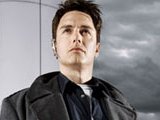 John Barrowman, the highly talented actor who brought Captain Jack Harkness to the screen in Doctor Who, obviously agrees with my comments about the dire Torchwood. Read the article here and my post here.
"Jack has a different persona in Torchwood as he does in Doctor Who, if that makes any sense..."
It makes perfect sense. The bright, charming, lovable rogue in Doctor Who has become a right miserable sod in Torchwood.
Barrowman explained: "He’s darker because of his circumstances and he’ll change again when [he] comes in, or he might be darker when he comes back in Doctor Who."
So wait. He's either go back to being the same cheery character we knew and loved in Doctor Who? Or he won't.
Glad we got that cleared up.
Tuesday, December 19, 2006
Holy Freakin' Nuts! Why people with a Peanut Allergy annoy me.
 This is going to be a slightly controversial post, because it focuses on a very real medical condition and how much it annoys me.
 Peanut Allergy.
I used to be sympathetic to people with a peanut allergy. After all, it's a horrific condition. All it takes is a few molecules of peanut to set it off and an allergic reaction can cause rashes, difficulty breathing and, in some cases, death.
It's a dangerous allergy and it's increasing. That's why you'll find just about all pre-packaged products with labels reading: "Free from Nuts" or "Made in same Factory as Nut Products." This allows people with the allergy to swiftly identify what they can and can't eat.
First thing that really annoys me about people with a Peanut Allergy: Why the hell do they have warnings like "May Contain Nuts" on packets of bloody peanuts? It's just stupid! If somebody with a peanut allergy picks up a packet of dry roasted and scoffs them down, perhaps it's just Darwinism at work!
Anyway. I fortunately don't have a peanut allergy. In fact, I think I have the opposite. I love peanuts. I could eat them all day long. In fact, one of the experiences I enjoy most is sitting on a plane with an enormous gin and tonic and a bag of salted peanuts.
But I heard a horrific rumour the other day that this simple pleasure would soon be denied to me. In fact, visiting Plane Insanity (an interesting blog about an air steward) I had my fears confirmed. Apparently, if there is a passenger with severe peanut allergy on your red-eye to London, they won't be breaking out the peanuts.
Let me just state that clearly. You cannot have any peanuts on your flight. Because of the one person sitting three rows down who's allergic to them.
Bloody hell! I think this is the most ridiculous thing I've ever heard. I'm literally angry with rage! How can you possibly justify denying a man his nuts?
The fact is, if a passenger with a severe peanut allergy boards a flight, there are negligible, but real risks to his health. Remember, all it takes is a few whiffs of peanut scented air and they're puffing up like an adder. And since all the air on a flight is recycled, the danger is increased.
But while I'm sympathetic to the dangers, I demand my rights. I paid £299 for this round trip to New York off Last Minute and I have no intention of anybody denying me my complementary peanuts. Give them to me now! If the bloke in P57 doesn't like it, I'm more than happy to show him how his parachute works.
That's pretty much the Second Thing That Annoys Me About People With a Peanut Allergy.
But then we get the third reason. The one that really annoys me. The one that makes me go purple around the jowls. People who only THINK they have a peanut allergy.
When I was working in Paris, I dealt with about 300 America students and the precautions we took regarding their health made the NHS look like a village Post Office. We had medical forms signed and notarized and full doctor's health records. I knew half of the kid's prescriptions off the top of my head. I knew which ones were ADD or OCD, even if I didn't quite know what those three letter terms meant.
We took the health of our students incredibly seriously.
And one thing I ran into a lot was parents who told me that their kids had a peanut allergy. So we'd take this seriously, make sure their food in the local restaurants was prepared without nuts and generally do everything within our power to keep them healthy.
And then what happened? I have to take a deep breath before I recount this, because it makes the vein in my forehead pulse.
I'd go up to their room in the Pierre et Vacances and find the little sod scoffing down a bowl of Crunchy Nut Cornflakes!
"Oi!" I would shout, sounding a bit like Michael Caine. "What the bloody hell are you doing? You've got a bloody peanut allergy!"
"Mmmmgh," they'd tell me, their mouth full. "Mgh murumph murumph mmmph."
As much as it would have delighted me to rush them to the SAMU and watch the little sod get an andrenalin shot straight through the breastbone, it actually transpired that they ate a bowl of Crunchy Nut Cornflakes every morning and - in actual fact - the nut allergy their parents warned me about was one of the many fictional medical conditions protective parents invent before packing their kids off to study abroad.
So the Third Reason People With a Peanut Allergy Annoy Me (and this is the controversial one) is that some of them actually don't have an allergy at all.
Mind you, I've known a vegetarian with a wheat allergy who stole one of my hamburgers once, so I guess I shouldn't complain.
There. I've said it. I'm sure I will horrify some readers with this rant, but I had to get it off my chest. And please, please, if you've got a peanut allergy and you're flying to Miami or New York, give me advance warning.
Monday, December 18, 2006
Star Trek: The Next Final Generation
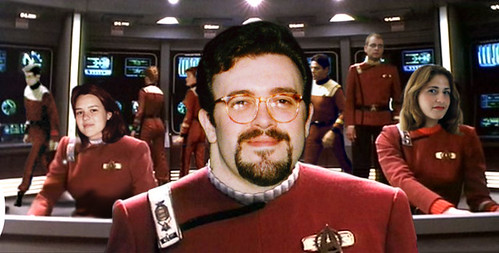
Captain of the USS Enterprise-B (one of the ones captained between Kirk and Picard) and legendary space hero. Also, one of the most dedicated 'Trekkies' in the entire world.
Marshall Oak, you see, has taken over 200 Star Trek photos and edited himself into all of them. Uploading them onto Flickr, a photo posting site, the magnificent Captain Oak has laid out the story of his Starfleet 'career' from the days at Starfleet Academy to his legendary run behind the wheel (does it have a wheel?) of the Enterprise.
I was about to write: "Geeze, this guy needs a hobby," but are his stories about Captain Oak's epic adventures any different from me writing my Adventure Eddy stories?
Well, actually, yes. At least I invented Eddy and his adventures and the world he lives in. I didn't just take somebody else's inventions and insert 'myself' into them.
But this post isn't about mocking Captain Oak, bless his Starfleet Regulation socks. There are enough people doing that already on the internet. And Oak, to give him his credit, takes all the jibes on the chin. He's happy doing what he's doing and photoshopping yourself into Star Trek seems a much more constructive outlet for obsessive behaviour than, for example, murdering prostitutes in Ipswich.
What I wanted to post about was Star Trek - and Captain Oak is a great example of Star Trek's enduring popularity and loyal fanbase.
But at the moment, there are no Star Trek movies on the horizon. The TV series has been cancelled. Why do studios think that the Star Trek franchise is no longer bankable? I mean, people love the show. They're even making versions of it themselves and - bloody hell, some of them are pretty good.
The fact is, the Star Trek franchise was pretty much run into the ground by Paramount Studios and the last few installments have been terrible. Star Trek: Nemesis was the last movie and it was a real mess. Just utterly, utterly terrible and a box office bomb to boot. Then the series Enterprise appeared and the over complicated story arcs and utterly incompetent captain (who seemed responsible for putting his crew into danger each episode, instead of getting them out of it) was just painful to watch. Even the last episodes of the pretty good Voyager ended up being dumb.
It's almost inconceivable that Paramount could take a winning franchise with a 40 year heritage and totally screw it up - but they succeeded. And I think I know why.
Two types of people watch Star Trek.
First off, there are the fans. The people like Marshall Oak, who dream of being Starfleet Captains and who can obsessively quote the Warp Speed of each ship in the fleet.
Then there are the people like me, who like Star Trek and think it's pretty cool - but we're not obsessive about it. If I catch one of the old movies on TV, I'll probably watch it (I love Star Trek II: The Wrath of Khan.) Most times, though, I can't be bothered to rewatch an episode of The Next Generation if it's on. But I did give Enterprise a fair crack of the whip and it was only when Captain Archer (Quantum Leap's Sam Beckett) repeatedly screwed up and got his crew into trouble AGAIN that I stopped watching.
In order to be a success, any new version of Star Trek has to appeal to the core group of obsessive fans and still be accessible to people who just 'stop in' like me.
And this is where Paramount have screwed up, time after time.
Enterprise is the best example of this. They decided to create a Star Trek series set before the days of Captain Kirk and co. Which wasn't really a smart thing to do. It meant they have four series of Star Trek to remain loyal to and anything that occured in the new series had to remain consistant with an established continuity. This put off casual fans like me, who felt that it was too much of an investment to get involed in. It also put off the Trekkies, who disliked the flagrant disregard for continuity (for example the Borg, first discovered by Captain Picard 200 years in the future, suddenly made an appearance to bouy up flagging ratings.)
Another thing that put off casual fans were the immense story arcs. Star Trek made itself popular by having self-contained 'episodes' which featured a beginning, middle and an end. You could sit down in front of the TV, having never seen an episode before, and enjoy watching Star Trek. With Enterprise, though, new alien races were introduced, plots were uncovered and the entire series slogged along like a space soap opera. Storylines took an entire series to wrap up, instead of just 45 minutes.
I sat down to watch the occasional episode of Enterprise and left wondering: "Who are these people? Who are THEY? What's going on?"
Then I'd turn over.
Finally, the thing that nobbled the Star Trek franchise was the drama.
Originally, Star Trek was envisiged as a 'Wagon Train to the Stars...' Gene Roddenberry pitched the show to the Network Execs like that because of the popularity of TV Westerns at that time.
Each episode of Star Trek was self-contained and involved the drama of saving lives, or saving the ship. The Captain had people he was responsible for and have to make tough choices in order to do what's best for them. It was a very human drama, based fundementally on the choices the characters make and what drives them to do what they do.
Star Trek: Enterprise revolved around saving the universe in what seemed like every single episode. Captain Archer, despite repeatedly proving that he wasn't responsible enough to command a fishing vessel, found himself being sent off to save the Federation every week and, you know what? The viewers just got desensitized to it all. We no longer cared...
Enterprise distanced us from the emotion and danger of space adventure. We no longer felt involved and that meant a lot of us no longer really cared about whether the crew would emerge victorious or not.
In the end, the Trekkies didn't like the fact that the canon they so loyally supported was mucked about with for the sake of flagging ratings - and the casual fans didn't like the fact that getting involved with the plot and characters was such an investment.
Where was the Saturday afternoon show that you could sit down, watch and enjoy? That's what the best Star Trek was and why it became so popular.
The production team lost focus and the viewers lost interest. And for that reason, a franchise that should promise slice after slice of fried gold has pretty much ended. There are apparently no plans to start another Star Trek series "for some years to come."
Which is a pity. The whole concept of Star Trek is exciting and promising. The people at Paramount should really get back down the basics and come up with a Star Trek series that delivers everything both Trekkies and casual fans want.
It can't be too tough, can it?
To answer that question, I'm going to invent a new Star Trek series that I feel contains all of the excitement and adventure required to make it a hit.
Star Trek: The Next Final Generation
When?
This exciting new series would be set during the last few series of Star Trek: Deep Space Nine. This was when the Federation was at war with a dangerous new enemy, The Dominion, who had come through a wormhole and allied themselves with the militeristic Cardassians in an attempt to overrun the Galaxy.
It's perfect, really. The universe is at war. There is a firmly established enemy. Federation ships face danger and destruction every day. Additionally, the period is already familiar to most fans of Star Trek as it's the time of Captain Picard, Voyager and Deep Space Nine. It's immediately accessible to viewers whether they're Star Trek Fans of not.
What?
The focus of almost all Star Trek series has been the ship. In my Star Trek series, there will be no exceptions. However, unlike in Star Trek (where the Enterprise is the flagship of the fleet) or Voyager (where the ship is the most advanced of it's kind) our ship will be a normal, basic Ship of the Line. An Excelsior class frigate called the U.S.S. New York.

Listen, it's my show. I can call the ship whatever the hell I want, okay?
I'm going to go a bit nerdish now, but this is all stuff I learnt from Wikipedia.
The Excelsior class ship was first introduced in Star Trek III: The Search for Spock. One of the most reliable and servicable designs, many ships of this kind continued to serve in Starfleet up until the Dominion Wars, eighty years later.
I think it would appeal to viewers of the show because it's instantly familiar. They've seen them about before in various incarnations of Star Trek. The choice is also important to the appeal of the show because the ship is nothing special. It's an old clunky warhorse. There are going to be no Deus ex Machina solutions to problems in my show. None of the old: "Oh, look, the saucer comes off..." or "Oh, look, the ship's got a cloaking device..."
Who?
The crew are the most important elements of the Star Trek mythos. Instead of having the smartest, most unique crew members, though, my guys are going to be decent, hard working men and women from the Star Fleet.
Captain Marcus Gordon
A seasoned officer, who has served with Starfleet for over thirty years. Tough experience has given Gordon a gruff exterior, but he is a warm, compassionate captain dedicated to his ship and crew. 
I picked actor Ron Glass to best portray our Captain. There's a warmth and charisma to the man that made him so good in Firefly. I think he'd come across as compassionate while also able to turn on that steely authority a captain would need.
Commander Lea Neale
Ambitious, focused and impatient, Lea Neale graduated top of her class from the academy and her Starfleet career has been a rapid scramble up the promotion ladder. One of the youngest First Officers in the Federation, Lea's professionalism and ability are offset by her arrogant personality and hunger for success, whatever the price. She's made quite a few enemies on her journey up the ranks and has few friends. She finds Captain Gordon frustrating to work with, as she considers him too slow and deliberate, whereas she is a woman of action. However, Gordon's seemingly limitless patience and friendship has won Lea's respect and loyalty.

For the role of Lea, I chose Smallville's Allison Mack, who could pull off unlikable and stern pretty well. I liked her because she's pretty, but not 'beautiful' especially compared to half of the skinny, exotic women on TV these days.
Lieutenant Commander Surek
Security officers tend to be aggressive, tough characters like Worf from Star Trek: The Next Generation. And I don't know about you, but if I wanted a guy in charge of my security, I'd like him to be a poster child for calm. So since we need a token Vulcan on our crew (like Spock) I thought Security would be the best place for him. Unemotional. Methodical. Unimaginative. That's Surek. As a Vulcan, and therefore unable to express his emotions, he finds it difficult to interact with the other crew members.

I thought actor Rick Yune, last seen in Die Another Day, would be perfect for Surek. A tall, muscular Asian man, he's got the defined features and colouring of a Vulcan and the on-screen presence to pull off a security officer.
Ensign Tate Auric
Lieutenant Tate is a Bajoran - therefore her last name is her first name. If that makes any sense. She grew up during the Cardassian occupation of her homeworld and at 13 was flying shuttles for the resistance. She has a natural instinct for flying and therefore makes an able and talented Helm Officer.
Tate is highly emotional and impulsive. As a teenager, she was lucky enough to join Starfleet Academy, but her quick temper and idealistic nature almost got her expelled on several occasions. Due to her experiences growing up, which involved unspecified brutality during her days in the resistance, she has an understandable hatred of Cardassians and is enthusiastic to be fighting against them. Tate is naturally suspicious, but once she has befriended somebody, she is fiercely loyal.
Captain Gordon befriended Tate early in her career and has used his influence to get her out of trouble more than once. For this reason, Tate looks up to Gordon almost like the father she never had and her loyalty to him runs very deep - to the point that she'll confront anybody who criticises him. This has caused several uncomfortable incidents between her and Commander Neale.

For the character of Tate, I thought Hard Candy's Ellen Page would be a perfect choice. 18 years old, Ellen manages to combine elfin looks (which would be appropriate given Tate's hungry, tough childhood) with a fiery temper and strong resolve. She's also got the dark eyes and hair that seem to be a characteristic of Bajoran characters in Star Trek.
Doctor James Mgambi
An Kenyan in his thirties, Doctor Mgambi is a talented and dependable medical officer who graduated with distinction from Starfleet Academy. He served on the front line during the battle of Wolf 539 (a battle in which the Borg utterly devastated the Starfleet and wiped out hundreds of ships and thousands of officers.)
Patient, with an excellent bedside manner, Mgambi is empathic and sensitive. However, he is still dealing with post-traumatic stress from the battle of Wolf 539 and this has caused him some severe mental trauma. He finds it uncomfortable to get close to people and therefore is really only close to unemotional Surek.
 I think British actor Colin Salmon (once tipped as the first 'black Bond') would be perfect to play Mgambi. Handsome, imposing and talented, Salmon would bring quite a bit of depth to the traumatised Doctor. I also like the idea of making him a real African (try out your accent skills, Colin) as there aren't too many characters like that at the moment.
Commander David Blake
David Blake is a human from an earth colony on a large planet orbiting Alpha Centuri. Like many of the colonists from this world, the high gravity has had the effect of encouraging a short, muscular build and as an eighth generation colonist, David is less than four feet tall.
David was accepted to Starfleet academy where he studied engineering, becoming an accomplished and talented engineer. He was the youngest Chief Engineer in Starfleet.
David has a bright, cheery personality and befriends people easily. Despite being only four feet tall, in the world of Star Trek he suffers no descrimination and is actually one of the most level and well adjusted members of the crew.

The idea of a four-feet tall Engineer came to me while I was looking for Welsh actors to play my engineer. I thought it worked out as quite a clever idea. After all, in the enlightened Star Trek Universe, there is no descrimination. So why not have a dashing British engineer who just happens to be four feet tall? Why should 'short' people only play Ewoks or comedy roles?
Which is why I thought Warwick Davies, who's played Ewoks, aliens and even Marvin the Android, would be perfect as David Blake. Warwick is a good looking, engaging guy with tons of charisma. I think he'd be an interesting character to ad to the mix.
So what happens?
Yay! Now I have the crewof the U.S.S. New York, who are serving in the front line during the Dominion War. Now, in order to make the series as accesible as possible, I want to make sure each episode is 'stand alone' and people who aren't fans can still sit down and watch an episode, out of sync, and enjoy it.
So here are some ideas for episodes.
Path of Least Resistance: The peaceful colony of Reo VI lies directly in the path of the advancing Cardassian fleet. The USS New York is assigned to make a much needed supplies drop before the Cardassians arrive. Away team member Ensign Tate is moved by the colonist's plight and wants to use her resistence experience to train them to defend themselves. Lieutenant Commander Surek coldly believes surrender will result in less bloodshed. With the enemy only hours away, what's best for the colonists?
Ships of the Line: Having stumbled over a hidden fleet of enemy ships, the USS New York and USS Somerset hide in a nearby nebula. However, the nebula is mined and the Somerset is severly damaged. Unable to call for distress or warn Starfleet while hidden, Captain Gordon faces the dilemma of abandoning the injured crew of the crippled Somerset, or allowing the enemy fleet to ambush Starfleet.
Price of Silence: Brutally ambushed, the fifth fleet limp away from their staging area. The USS Annapolis remains, crippled and powerless. The USS New York receives orders to return to the Annapolis minutes before the enemy fleet arrives. The USS Annapolis must be scuttled, to prevent the information stored on it's computers from falling into enemy hands. The dilemma? Over a hundred crew members still remain on the stranded ship.
Unforgiven: A high ranking Cardassian officer is going to defect and the USS New York is sent to recover him and the vital tactical information he's stolen . However, Ensign Tate discovers that the officer is the same man who brutally murdered her parents during the Cardassian Occupation - a man she's sworn to kill.
Pocket of Black: While on patrol, the USS New York runs into a Borg Sphere, powerless and drifting in space. While Lea Neale and Surek think it could be used as a brutal weapon against the dominion, Doctor Mgambi remembers his devestating experiences during the battle of Wolf 539. Activating the sphere soon treatens everybody on the ship.
Chain of Command: Stumbling over a crippled Federation ship, Captain Gordon and the away team try to rescue the survivors. However, an ambush by Dominion ships leaves them stranded and puts inexperienced Commander Lea Neale in charge of the New York. Clashing sharply with the more experienced, resentful crew, Lea struggles to rescue her captain and establish her authority as First Officer.
There we go... Easy as breakfast.
In the space of just a few minutes, I've created a sterling reinvention of the Star Trek mythos. Come on. Surely the highly paid Hollywood scriptwriters could match lil' ol' me. I don't even claim to be a Trekkie.
Viacom and Paramount take note. Star Trek lives on in the hearts of millions of fans. All you need to do is take the elements that made it so succesful and give them back to them.
Sunday, December 17, 2006
Russell T. Davies SUCKS.
 The jury was still out on Doctor Who spin-off Torchwood - until today.
The episode was a brilliant idea - about a plane (a Dehavilland Dragonfly, actually) landing at Cardiff Airport 53 years after it left. The Torchwood team was responsible for reintergrating it's three passengers into a world that had moved half a century forward while they'd been gone.
At the end of the episode, the dashing, brave, loves-life-to-the-last Captain Jack watched one of the arrivals gas themselves to death with exhaust fumes. In his mate's car.
Click. Off went the television.
It an unsteady run, this episode was the one that killed it. Dead. Torchwood is crap.
Torchwood was created off the back of Russell T. Davie's brilliant reinvention of Doctor Who. I was lucky enough to catch a re-run of The Christmas Invasion today and I was reminded that Davies has taken ownership of the most compelling British TV series on TV at the moment. He's done a brilliant job, which is why Torchwood has been such a disappointment.
The seeds of Torchwood were laid throughout Doctor Who. A secret group responsible for scavenging alien technology to advance the human race. It was an interesting premise - a kind of X-Files for Britain - and I was interested to see what it would be like.
Even better, Russell T. Davies took one of the best things from Doctor Who - the character of Captain Jack - and cast John Barrowman as the star of the new show. At this point, I was excited. Captain Jack is like Doctor Who with edge. Brilliant, exciting, dashing - and he'll shag just about anything, male, female... Lock up your housepets.
If Captain Jack had been that smiling, brave and resourceful character from Doctor Who, I would have been glued to Torchwood. But in the interests of "character development" he has popped up again as a supporting character. Miserable. Lonely. Whatever occurred to turn him this way might have important ramifications for the Torchwood story arc, but it was out of character for Captain Jack.
Tonight, letting another man die just because he was "scared" to go on living, was a fairly firm indication that the script writers don't know anything about Captain Jack's character or what made him such a firm favourite with the fans.
It's a pity. John Barrowman is awesome and could have made this show.
There are other reasons why I don't like Torchwood. Russell T. Davies, who is gay, makes a big point of keeping his character's sexual orientation open. But instead of being progressive and innovative, the same-sex coupling that occurs each episode seems at best to be crow-barred into the story - or at worst just gratuitous.
Bisexual characters are fine, Russell. To be applauded. But the world in which Torchwood is set is not as progressive as your sexual manifesto and these same-sex relationships come off as contrived and totally non-believable. Only Captain Jack - who comes from a more enlightened time - could pull it off... But like with most of Captain Jack's compelling attributes, they've been firmly written out of the series.
Then there are the supporting characters - limp, unattractive, one dimensional and unbelievable. Then there's the sheer ram-our-face-in-it-Welshness of the whole thing. Doctor Who quite happily inserted Cardiff into many of it's storylines without being like an ad for the Cymru tourist board. Torchwood simply isn't subtle enough.
The swearing annoys me too. Russell, Mate. Saying "fuck" a lot isn't big. It isn't clever. It doesn't give the show any more depth. I'm as much a fan of the potty-mouth as anybody else (Goodfellas, one of my favourite movies, dropped the F-bomb hundreds of times) but it doesn't add anything to Torchwood.
And finally, it's just miserable. It's just a blood miserable show. At the end of each episode the characters are given new emotional scars (on their blank character canvas) and something depressing happens. Doctor Who was escapist and uplifting. Torchwood would have been better if it was too.
Basically, Torchwood had a lot of potential and didn't take advantage of it. It's helmed by Russell T. Davies and the man's bloody talented. But I think he lost sight of why Doctor Who was successful. He stayed true to his Welsh roots when he created Torchwood, which probably explains why it's raining in every episode and the characters are miserable.
Torchwood is on BBC3 at 10pm every Sunday. Bring Prozac.
Wednesday, December 13, 2006
How to become a Voice Over Artist
 Every single day, the postman delivers dozens of CD's to the radio station.
There are the latest singles from the hottest artists. There are tracks from aspiring pop stars and local bands, desperate to get on air. There are the latest production music CDs...
And then there are the CD's from aspiring Voice Over artists, looking to break into the world of commercials.
Which is why these CD's end up on my desk.
Now, with all the production CD's I get, plus the hectic schedule of writing ads and sending them off for production, the time I have to listen to aspiring VO's and their home made showreels is limited. But I work with Voice Over artists (via the production gurus in Nottingham) pretty much every day, so I thought I'd present some advice on how to get into the Voice Over game.
What is a Voice Over?
It sounds like a cushtie gig, being a Voice Over artist. You sit in a studio and read off a piece of paper. Your voice gets recorded. You receive a cheque and toddle off to the pub. Then, while you're waiting for your kebab, you hear your voice over the radio.
And that's pretty much it. Somebody has to read the commercials for Koi Carp and Dodgy Sofas. And if you've got a decent voice, why can't it be you?
If that's what you're thinking, you should be aware that plenty of other people have thought it as well. That's why getting into Voice Over work is a surprisingly difficult and competitive business.
But it can be worth it.
Established voice over artists can make quite a respectable income through voice work. The VO's we use tend to record five or six commercials in a sitting (for transmission to several different stations across the country) and get paid about £20 for each. Depending on the size of the station, this rate can go up quite sharply. Your voice on a national advert, or broadcast on Capital FM in London, could theoretically earn you an Equity rate of several hundred pounds.
Before you get too excited, though, be aware that the rates for Voice Work are only as high as the production companies are willing to pay. It's such a competitive business that if you're not willing to work for the fee they're offering, the chances are somebody else will. So don't get dollar signs in your eyes when I tell you about Capital FM and Equity Rates. If you're able to get into Voice Work, you can expect about £15 to £20 per commercial you record.
Top Ten Tips for Breaking into the Voice Over Business
1: Produce a Show Reel CD. This is a bit of a no brainer. Unless you get your Show Reel out there, nobody will hear your voice and 'discover' you. But the biggest mistake most aspiring Voice Overs make is sending out crap.
Radio stations get hundreds of CD's sent to them every day. A blank CD burnt on your home PC, with 'Dave's Showreel' scrawled on it in marker pen, is going straight into one of those mysterious filing cabinets all radio stations have (which are full of crappy CD's dating back to the early nineties.)
If you're trying to convince a producer that you're a hard working, professional Voice Over, make sure professionalism just drips off your CD. Invest in some smart jewel cases and CD labels and produce something good looking. A cost effective method is to buy some of those plastic wallets and print out colour CD labels. That will look neat and professional.
Make sure WITHOUT FAIL that your name, email address and telephone/ISDN number are printed on your CD. Because your letter and jewel case will go missing. Guaranteed. Even if your CD gets played and your voice is good, nobody is going to root through the trash for your telephone number.
A picture is a good idea, too - even if you have 'a face for radio.' Just try to avoid the kooky gurning or red-eyed, blurry pictures of you in the pub. You think it's unique and original. So did all the other chumps who sent in practically identical photos.
2: Invest in ISDN. ISDN is a high quality phone connection that enables you to link directly to a production studio and talk in real time at CD quality. Most professional VO artists have ISDN set up in their home and work from a 'studio.' (This studio often doubles as an office, bedroom or landing!) If you don't have ISDN, the only way to record your voice at the required quality is to actually go to a studio at a radio station or production company and record your work there. That is expensive and inconvenient. For that reason, producers will never normally select a VO artist unless they have ISDN at home. So don't shoot yourself in the foot. If you can afford it, invest in ISDN. You'll find your opportunities severely limited if you don't.
3: Get some Experience. It's a catch 22 situation. Producers want a voice over artist with experience, who knows what to do and can deliver it quickly and efficiently. Producers are incredibly busy people (hell, I know ours are) and it's often unwise to risk an untested Voice Over when recording ads. An experienced Voice Over can shoot through a script in a couple (more like a dozen) reads. An inexperienced Voice Artist will need to be led through the script line by line. Producers don't have time for this, so they'll always take an experienced voice over a green one.
So to give yourself a head start, get some experience. You might have to bite the bullet and offer your VO services for free at first (in which case a producer might be more willing to give you the guidance you require.) Alternatively, a great way to practice can be found at your local library, where they often accept volunteers to read newspapers and books onto CD or tape for the visually impaired.
4: It's a Numbers Game. The legendary Gif Gifford put sales into a very simple equation. If you ask 100 people to buy your product and one accepts, you've made one more sale than if you asked nobody. When soliciting for VO work, you're basically selling yourself and it's exactly the same numbers game. There are 500 commercial radio stations in the UK, plus lots of RSL (temporary radio licences awarded for short periods) and plenty independentant production companies (like Mutt 'N' Jeff.)
Send out your showreel to all of them. You can get the addresses from www.yell.com or other places on the internet. And once you've mailed them your showreel, don't be afraid to pick up the phone and give them a call.
5: Find a name. If you just write the station name on the envelope, your showreel will end up on that pile of mail the receptionist opens (at big stations) or the work experience lad tears open (and most stations.) If you can find out who does the commercial production, or the name of a producer, make sure to address the envelope to them. Then it will at least hit the desk of somebody who's in the chain. Try looking at the station's website for the appropriate name or, failing that, send them an email or pick up the phone.
One thing I learned in radio: Everybody has an ego. If I get an envelope with my name on it, I'll treat it with a lot more seriousness than just another jiffy bag marked: "Comm Prod."
6: Be Polite. One other thing I learned in radio. It's a small business and if you piss somebody off, it'll almost certainly come back to bite you in the arse. People swap companies, change stations... Whoever it is, if they stick around in the radio game, you'll run into them again. I often meet my old boss Tim Nice in Badger Farm Sainsburys.
So if you are lucky enough to get some voice work, do everything ask of you with enthusiasm and dedication. Be polite. Because I have it on authority that a difficult voice over will not be given more work if there's another VO available - and if this guide teaches you anything, it's that there are PLENTY of other people out there wanting to take your Voice Over contracts for themselves.
Producers are very, very busy people. Being professional, polite and flexible is the quickest way to establish yourself as a good bet whenever they need a voice.
7: Be Online. With broadband and ISDN, producers don't rely on piles of CD's to find their production tracks or voice artists. Websites like KPM and BMG Zomba allow them to download tracks at broadcast quality. One site in particular, Voiceovers.co.uk, allows them to do the same with voice artists.
If you are serious about Voice Over work, sign up to voiceovers.co.uk. It will establish your credibility and enable producers to find you quickly and easily. Signing up there wonnecessarilyily make your career as a voice artist - but it will get you some work from producers who don't know you and offer a useful route for producers who do.
Another option is a website with your information and showreel on. List your experience and update your showreel when and if you can. It's a good thing to include the website address on your showreel CD so producers can find out a bit more about you.
Like with your showreel CD, the more professional your website looks and sounds, the more seriously it will be taken. If you're not a professional website designer, think about using something like myspace.com to highlight your work. It will allow you to have a smart, clean looking presence on the web without a degree in HTML.
8: Be Good. This sounds like another no brainer, but it's not. Sure, you might talk all day long, but that doesn't mean you'll be a good voice over artist. Practice. Get experience. Take criticism and guidance from producers. Do whatever it takes to improve your voice. One good idea is to record yourself reading a passage from a book and play it back. If you listen objectively, you'll be able to quickly identify what parts of your delivery need work.
Newsreaders get coached on how to speak, so I don't see why Voice Overs shouldn't have to as well. There are courses available and you would be surprised at how much they can improve the way you perform.
9. Be different. I just broke all of the above rules. I called up a Voice Over artist. I paid him above the odds. And he didn't have ISDN. We actually had to bring him into the studio to record his lines.
The fact is, the guy had an entirely natural Caribbean accent and experience doing voice overs for the BBC. When I wrote a script for Southampton's only Caribbean restaurant, his was the only voice that would fit the bill. Because there's nothing worse than somebody pulling a fake accent and demanding to get paid twenty quid for it.
If you have a different accent or a unique spin on things, you may well find that your accent earns a premium. But be careful. The same reason your accent is in demand might well be the reason your voice isn't chosen for more mundane projects.
10. Be lucky. At the end of the day, there are so many reasons why some people make a good living from being a VO and some more talented people don't. But one of the major ones has to be luck. Luck running into the right scriptwriter or producer. Luck at getting your showreel into the right hand. In fact, it's an entirely arbitory process.
The sad fact is, voice overs get work every single day. Watch TV? Each advert has two or three voice overs on it. The same for radio. But the truth?
Nobody got famous from voicing a washing powder commercial. And if one voice wasn't there. Wasn't good. Wasn't affordable... They weren't picked. Somebody else was.
Well, that's not strictly true. Remember Tony the Tiger? They're Grrrreat?
The guy who voiced the commercials was called Thurl Ravenscroft. And he did the voice over for the world's favourite tiger since 1951.
So maybe I'm wrong. Maybe somebody did get famous from voicing commercials. And maybe the next Thurl Ravenscoft is you. So get up and get your showreels into the postbox.
Friday, December 08, 2006
All My Own Work

Who is Stephen Miles, you might ask? Well, Stephen is a writer and a winner of the Leonard Sankey Award for New Talent in Fiction. A title he and two other winners were controversially stripped of in 2002.
The circumstances regarding that decision - and why Stephen was the only one of the three to appeal against what happened - makes for fascinating reading. You can discover everything in his book All my Own Work... But the process of putting that story into print is almost as incredible as the Leonard Sankey adventure itself!
The more I've discovered of this story, the more fascinated by it I've become, so I do recommend his book. It's published through Lulu via a publisher called Thoughtcat and you can find more about it here.
In the mean time, I've been lucky enough to speak to Stephen Miles about his book. My questions start off a bit confusing. I'd got some of the details mixed up, which is why I didn't go too far into the story in this introduction. Sorry about that!
Q: While the Sankey Award and All my own Work are the things people will concentrate on, you were a writer long before you heard of Sankey. How exactly did you start writing? What sort of writing did you do? Did you have any previous success with it?
A: I've been writing for as long as I can remember. The first story I wrote which registers in my memory is something for an English class when I was about eight, about a small boy who climbed a mountain. Sadly it was all downhill from there until Sankey. And then it was downhill in a different way...
Q: So the Sankey Award for New Talent in Fiction. How did you hear about it? What inspired you to enter it? What do you think it was about your entry that contributed to you being selected as one of the winners? In tangible terms, rather than just raw, pulsating talent!
A: I read about the contest in the Independent. Leonard Sankey had recently died but altered his will at the last minute to use his fortune to fund a competition to encourage unpublished writers. As for why my entry was selected, I'd like to think it was just well written and involving enough to make the judges want to read on. That's about as tangible as it gets.
Q: So out of the five Sankey award winners, three (yourself included) were disqualified for apparent Plagerism. Out of those three, you were the only one to stand up in defiance of these charges. First off, who exactly were you accused of plagerising? Why do you think you were the only person to refute the accusations?
A: I think you mean "plagiarism" :-) but actually that's not what happened with Sankey - you might be thinking of what happened later with my co-writer. The Sankey debacle is a long story, but in a nutshell I'd split up from my wife and didn't know where she was, and had this mad idea that if I won a high-profile competition like this one not only would my writing career be sorted but she would get back in touch. When the stakes are that high you'll consider all sorts of dodgy ways of trying to increase your chances of winning. I didn't plagiarise anybody when I entered the competition, and nor did the other two winners, but I did do a deal with them to try to increase my chances. The so-called plagiarism thing came about when I wrote All My Own Work, which is my story of the Sankey affair from the time I met my wife to the time everything went pear-shaped with the competition. A writer friend did some editing of that story and we fell out over it, the upshot being that I was accused of plagiarising my own book. All very surreal.
Q: Don't you find it odd that 60% of the winners (whose prizes totalled £30,000) were accused of plagerism?
A: As I say, plagiarism wasn't what happened in the Sankey contest. All My Own Work tells the story of how I and two of the other Sankey winners got together and cooked up a scheme which was initially a brilliant success, but then backfired disastrously. I deserved it really.
Q: Things didn't get any better after that! Then you teamed up with somebody to write your side of the story. How well did you know this person? And how did you feel when the copyright issue first cropped up?
A: I knew Richard very well. He is, to be fair, a good writer but we didn't really look into all the ramifications properly from the outset. We're back on speaking terms now but it was ugly for a while. I would strongly advise any writer thinking of collaborating with another writer to think hard about it first and see if you can't just do it yourself. It's very hard to please both of you in the equation and lots of misunderstandings and egos get in the way.
Q: Like a persistant pheonix, All my Own Work rose from the ashes in the form of an online blog. What inspired you to do this and how effective do you think it was?
A: Well I think blogging is great in principle because it gives you a voice and, potentially, a global audience. But in reality there are many more blogs than there are readers, or at least people who have the time and inclination to read blogs, and in fairness a lot of blogs are dreadful. All My Own Blog seemed an obvious thing to do. Originally I was going to publish the entire story online but I was more interested in the traditional book form.
Q: All my Own Work is now published. How exactly did that happen? Did you pitch the manuscript and story to publishers? Why did you pick Thoughtcat as publisher?
A: I did indeed try to get All My Own Work published in the usual way by submitting it to agents and publishers, and had generally positive responses, but for whatever reason none of them wanted it as it stood. Some had suggestions for how it could be improved but it would've meant taking out great chunks of the story I wanted to tell. Thoughtcat is an interesting web phenomenon that Richard is involved in and as part of our deal he agreed to publish it in its entirety.
Q: Thoughtcat is a fairly unique form of publisher, taking advantage of the Lulu POD service. How do you feel about that?
A: Well, Lulu provide an excellent service and I'm delighted that we're working with them. The quality of the books they produce is superb, their prices very reasonable and their service is extremely quick. I think POD is a very democratic thing and is the way forward for books that don't fit into the mould that regular publishers and agents seem to be tied to.
Q: Now you've got All my own Work in print, what's next? Do you have any more projects you're working on?
A: I'm always writing something or other, although most of it ends up in a sub-folder of My Documents called RUBBISH. You have to write a lot of rubbish to get to the decent stuff. I'm working on a screenplay at the moment but I'd rather not say any more than that.
Q: How do you go about writing? All my own Work mentions the dozens of notepads you used. Was that just because you were on an island, or is that the medium you prefer?
A: I've always preferred to type, mostly because my handwriting is dreadful. It was beautiful when I was at school but as I grew older it became increasingly illegible. There was always a little manual typewriter at home because my mum and dad ran a grocery business and needed it for that, so I taught myself to type at quite a young age. Then computers came along and I got into wordprocessing when I was about 15. It's so normal now but in those days (the mid-eighties) it was still very new. It's by far my preferred method of writing now although I do agree it has drawbacks. Martin Amis once pointed out that because of the "delete" key you can lose text forever that might actually be good, and Stephen King has spoken of the distance that wordprocessing can put between the writer and the words. And then of course there's all the crappy features that word processors have now, 95% of which are completely useless and get in the way of writing. You end up fiddling with fonts and rulers when what you should actually be doing is writing the bloody story. I wish I was able to say that was the reason I drafted the Sankey stuff in notebooks but in truth that was because I was working in a hostel on the Isle of Skye at the time and didn't have my own PC in my room, nor the money to buy one. I used sheets of yellow A4 paper as well because there was a lot of it lying around at the hostel for some reason. It actually ended up being quite an instructive process because I found that slowing my brain down to the speed of my handwriting produced better results. Of course now I'm back living in my own place in London I'm using the wordprocessor all the time and my handwriting has disintegrated again. I print everything on yellow paper now though rather than white, as it seems lucky.
Q: To win the Sankey Award, you had to give a synopsis of your unwritten novel. Is that the way you normally work? A lot of writers (including Stephen King) just 'sit down and type.' Is planning important to what you write?
A: Well the synopsis was a requirement of entering the Sankey contest, because they judged your entry on the basis of your first chapter and then the summary of the rest of the story. In the past I have tended very much to plot my stories very closely before starting to write, but I've found that to be extremely limiting and also it spoils the fun. I've forgotten who said it originally but if there's no surprise for the writer, there's no surprise for the reader either. It's very tempting to write lots of notes for a book because you can tell yourself that "eventually" you will start writing it, but all you're really doing is putting off the act of writing the thing. I have a lot of admiration for writers who can follow their instincts and write without an outline, because they might get halfway into a book before realising it's not working, and have to abandon it. I think the best thing is to write just a few notes and put the majority of your effort into the actual writing. Sebastian Faulks once said that the only notes he had for a 100-page section of his (superb) novel Birdsong consisted of just three words. I've forgotten what the words were but it obviously did the trick.
Q: What's the process between 'spark of an idea' to sitting down and actually writing the first chapter?
A: That's a good question. I think Stephen King has said that he doesn't write the "spark of an idea" down at all, but instead leaves it in his head until it's grown and is nagging at him so much that he can't bear to put off writing the book any longer. Then I think he just starts on chapter one straight off. There's a lot to be said for that approach, if you can stand it. His self-control must be awesome.
Q: What sort of editing process did you use? How different was your finished first draft to what you can actually purchase from Thoughtcat?
A: It wasn't a great deal different, to be honest. It was a straight account of the story, and like I said I didn't want to cut too many things out even if they didn't seem absolutely integral to that story. A book is a large enough canvas, I think, for the writer and reader to be able to share a space and relax in it together for a while.
Q: Got to ask... Who designed the cover?
A: That was done by Thoughtcat. I think they did a pretty good job of capturing the tone of the book and its subject in one image.
Q: What advice do you have for any aspiring writers?
A: Well my gut reaction is "resist the temptation to write too many notes before you start writing", but some writers do this and it works for them. So really I don't think the technique matters much - do whatever works for you. What does matter is finding your own voice, identity and subject. All My Own Work is my first full-length book and I think the reason it worked this time is largely because I was just telling a story I knew well in a tone that felt comfortable. It felt less like writing and more like having a conversation. Of course some of the time I was actually having a conversation with Richard at Thoughtcat but that's beside the point. There's a lot to be said for borrowing the style of someone great like Hemingway or Russell Hoban when you're starting out, to get your foot in the door of writing, but ultimately the important thing is to be yourself and do your own thing without fear of what other people might say.
Thursday, December 07, 2006


In all honesty, I hated the eighties...
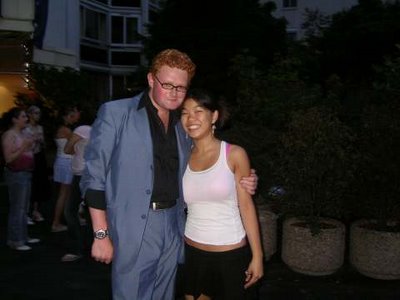
The Olden Days...
It's the shirt, isn't it?
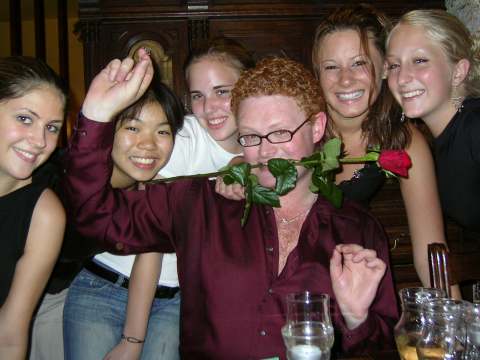
Still, those were the days...
Sunday, December 03, 2006
Signs your publisher isn't on the up-and-up...


I'm sure the Gouldings will be pleased that their editor has such attention to detail - especially considering the mistake was on the book's cover.
I actually tried to email them to mention the mistake, but they'd misspelled their own email address: sterlinghosue.
And they seriously expect authors to pay THEM money? Because that's essentially what they do. Expect payment for printing books which the author is then lumbered with selling.
As far as vanity presses go, it's a pretty poor one that doesn't even invest in a spellchecker...
PublishAmerica - Selling dreams at $20 a pop...
I think Adventure Eddy is a great book, with a great concept and a real market out there... But I'm not going to kid myself. As Miss Snark pointed out on her website, out of 500 queries, publishers will normally contract only one. So my chances were 500/1.
And that's with an agency, let alone one of the best publishers in the UK.
But apparently, there is a publisher out there willing to take on new, untested talent. They're called PublishAmerica and they proudly declare that they are America's number one publisher.
 I took a look at PublishAmerica, because I was curious about the chances of getting my book in print. What they offered seemed very exciting.
They will take a look at your book and, if it's acceptable, 'take a risk' and publish it. In return, instead of giving you a big advance like most publishers do, they will give you a 'nominal' advance of $1 to offset the financial risk they face backing your work.
Once PublishAmerica take on your book, it will be available in bookstores and online - but they make it clear that the investment of marketing the book is left to the writer. After all, they're only giving you a $1 advance!
So in theory, your book is published, available in bookshops and on Amazon, and you're a published author. Way to go you!
Except further research into PublishAmerica reveals that this isn't quite the real picture.
Because PublishAmerica will publish ANYTHING. I mean, seriously, anything. Several independant 'studies' have been done on this subject, including sending PublishAmerica the same thirty pages of script repeated ten times. And they accepted it.
In fact, it looks like PublishAmerica will publish anything - hence why they're America's number one publisher. Because they have more published titles than any other publisher in the USA.
Why on earth would a 'traditional publisher' (like PublishAmerica claims to be) publish any old crap? I mean, publishing is a really tricky business. There's not much return on the investment of printing books. To make it cost effective, you need print hundreds of the buggers and expect a dollar profit on each, at best. So if they print total, unmitigated crap (like PublishAmerica do - and google 'Atlanta Nights' if you don't believe me) then who is going to buy them?
The truth is, PublishAmerica don't publish the books they accept.
When you look at the organisation closely, you discover that they actually resemble Lulu more than a 'traditional publisher.' They are basically a 'print on demand' company.
Because when they tell the author that marketing is left up to them, that means all forms of marketing, including getting the book into the bookstores, is left to the author.
Bookstores, like Waterstones or Barnes and Noble, accept books with a 35% discount and the safety net of being able to return them if they're not sold. Publish America offer no discount on books (sold at high end prices of $20 each) and because they only print books when they're asked for (so they don't rack up the costs of unsold books) they don't accept returns on the books. So if your book is published by PublishAmerica, the author first off has to get Barnes and Nobles interested in stocking the book in the first place.... and then explain to them why they're not making any money on each copy they sell (on an $18.95 book a bookshop can expect to make $6.63 on each copy sold. Publish America give them .94 cents.) Then, if they have stocked a few copies of your book and they don't sell, the bookstore has to suck up the costs because there is no return policy.
Basically, PublishAmerica make it impossible for the books to even find their way to the bookstore. They are available online. That's about it.
So PublishAmerica don't print these books and they don't stock them in bookstores and they don't invest in any form of marketing. So far their outlay is $1 to the author... But where do they make their money?
The sad truth is, PublishAmerica exist almost entirely on the money made from the author, and friends of the author, and family of the author, buying copies of the book. PublishAmerica invest a couple of bucks that they recoup tenfold on the two or three copies of the book the author and his friends/family buy.
And the sad truth is, because of the way they're set up, they're the only sales PublishAmerica authors can expect to get. And that's how the company operates. They're basically an author mill.
It's horrible. As a writer, I know there is no better feeling in the world than getting your book in print. It's something you're hungry for and desperate for. And that's what PublishAmerica count on. They exploit that need to get published and milk poor, hopeful writers for money they can ill afford to spend. They take your dreams and charge your for them.
Finding out about PublishAmerica at least reassured me. Even if I am rejected by the publisher I've sent Adventure Eddy to - that rejection's far less to deal with than exploitation by unscrupulous companies like PublishAmerica.
If you know any aspiring writers (apart from me) then please tell them to steer clear of PublishAmerica.