Here in the radio business, we've all been paying careful attention to the new Solent licence - Original 106.
They are in direct competition with Ocean FM, Power FM and Capital Gold Hampshire (deeze are my peeps.) They're also stomping firmly on Wave 105's footprint (nice and heavily, I hope.) Some smaller stations, like The Quay 107, The Saint and my friends at 107.2 WinFM might be impacted as well.
Marketing wise, anyway. In terms of listeners, they have a strict mandate to appeal to the 'older' end of the scale. I think it's actually 55+. That puts them up against Capital Gold, but with an FM licence they're got (in theory) a distinct advantage.
Which is why I was incredibly surprised to hear that they've got Simon James and Hill leading their presenter line-up.
In case you're not familar with them, Simon James and Simon Hill (hence Simon James & Hill) are two lads in their thirties who fit neatly into the Chris Moyles/Johnny Vegas mould. They ran the TLRC network shows for about a year (from 7pm to 11pm on all 27 Local Radio Company stations) and before that had a very succesful drive time show on the Emap stations.
They appeal to a youth audience. They're rude, crude and incredibly pleased with themselves. They've won three Sony awards, so I shouldn't bitch, but whoever put them on the lineup for a 'senior' station needs their head examined.
Or do they?
In all honesty, I think this move follows their activity in the South's market place. They won the licence based on a platform that would appeal to the senior listeners - the only reason why a new licence would have been granted in such a 'busy' area - but right from day one, they're going to be ignoring their mandate and trying to appeal to the 'everyman.'
Just like every other commercial station.
I'll be interested to see how things pan out for them. I think they'll find it really tough establishing themselves against Wave 105 and the TLRC network - who basically share a poorly thought out 'common' playlist. It'll just be another station playing the same old crap.
As Phil proved at WinFM, and as Power FM and Ocean FM are doing so successfully at the moment, the real way to make an impact on commercial radio in England is to deviate from the safe and derivative path of most commercial stations and make your own mark in the marketplace.
Original had an incredible opportunity to do that - but I've got a feeling they've blown in from day one.
Original 106 starts transmitting from October 1st.

Saturday, September 30, 2006


Friday, September 29, 2006
The Green Menace
Oh, the irony!
When I was a kid (you know, twenty five-ish) my parents tried to feed me vegetables. Broccoli. Peas. Anything green, really. They told me I'd like them if I tried them.
Yuck!

My father warned me that when he was a boy, his parents used to tell him asparagus tasted disgusting - just because they wanted more of it to eat themselves. It was a pitiful reverse psychology ploy! But I'd like it if I tried it.
I don't know why. Maybe it's because your taste buds regenerate every seven years. Maybe it's because I hadn't actually been talked into trying it a few years ago. Whatever the reason, I discovered they were telling the truth.
Asparagus rocks!
Boiled, baked, microwaved. As long as it's soft yet crunchy and covered in melted butter asparagus is THE BOMB. I love it.
Dammit. My parents were telling the truth. Some vegetables are nice.
When I was a kid (you know, twenty five-ish) my parents tried to feed me vegetables. Broccoli. Peas. Anything green, really. They told me I'd like them if I tried them.
Yuck!
My father warned me that when he was a boy, his parents used to tell him asparagus tasted disgusting - just because they wanted more of it to eat themselves. It was a pitiful reverse psychology ploy! But I'd like it if I tried it.
I don't know why. Maybe it's because your taste buds regenerate every seven years. Maybe it's because I hadn't actually been talked into trying it a few years ago. Whatever the reason, I discovered they were telling the truth.
Asparagus rocks!
Boiled, baked, microwaved. As long as it's soft yet crunchy and covered in melted butter asparagus is THE BOMB. I love it.
Dammit. My parents were telling the truth. Some vegetables are nice.
Thursday, September 28, 2006
Did I fund terrorism?
I read some shocking news this morning about National Westminster Bank.

Apparently, a court in Brooklyn has ruled that victims of suicide bombers in Isreal are allowed to sue the bank for funding the Palestinian terrorist group Hamas, through a UK Charity called Interpal.
I was horrified. I've been a customer of Nat West for 21 years. Does that mean I've been supporting terrorism myself?
T and I discussed it this morning and we were all set to close our accounts and move to a different bank. I have always thought very highly of Nat West, received fantastic customer service and feel that we get great value for money.
But they gave money to Interpal, a charity group that was declared by the US Government a "Specially Designated Global Terrorist" in 2003. This group apparently directly funded the terrorists of Hamas.
Just before we picked up the phone, though, I decided to dig a little deeper. And I found out some equally surprising things.
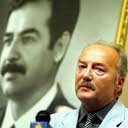
Yes, National Westminster Bank did give money to Interpal. Interpal is a UK Charity which raises money for relief and development in Palestine. It has been the focus of intense media scrutiny regarding it's links to Hamas. Their reputation isn't helped by the fact that one of Interpal's supporters is sleazy, self promoting, immoral crook George Galloway.
In 2003, the United States Government published a list of charities with alleged links to terrorism. The publication of this list led to Interpal's assets being frozen and the UK Charity Commision launching the first of two five week investigations into the conduct of Interpal. The United States government was requested to provide the evidence which had led them to including Interpal on this list.
What evidence did the US Government provide? None whatsoever.
As a result, Interpal was cleared of any wrong doing and allowed to continue fundraising.
Which kind of takes legitimacy out of the court case in America. National Westminster bank is being held liable for 15 suicide bombings but the crux of the case - whether Interpal is linked to Hamas or not - has not been supported by any actual evidence. It's simply being taken as established fact without having to be backed up by anything.
The US Government stamps a folder and says: "This is the truth. Accept it."
That dog won't hunt, Monsiegner. I make opinions based on evidence, not blind alligence.
So because there is such a gaping hole in the allegations being made against Nat West, T and I will not be moving our bank account.
That doesn't mean I'm happy about my bank donating money to Interpal, though. The fact they've got a windbag like Galloway supporting them, and the BBC declared them supporters of a "jihad ideology" means they're written out of my list of deserving causes.
I will write a VERY firm letter suggesting they donate the money to Battersea Dogs Home instead.
Wednesday, September 27, 2006
Writer's Block
 I've had a lot of time to think about this dreaded condition over the last few days. I've suffered "performance related anxiety" in both my personal and professional writing.
Work wise, I have been writing a series of scripts for the Hampshire Primary Care Trust and their Smoking Cessation Program. Basically, a quit smoking program for people in Fareham and Gosport.
Their boss had heard a series of commercials in Canada that he wanted us to use as inspiration. His brief was, to be honest, complicated.
They had to be tips to quit smoking. The ads started off with "Quit tip 10" or whatever. In reality, there would only be about six or seven commercials, but the numbers would suggest a rotation of many more.
Then, they had to present a tip to help people who had quit smoking. These tips had to be from the official 23 on the givingupsmoking.co.uk web address.
This is where it gets complicated.
Because the tip had to be practical and logical and presented in such a way that it would offer an aspirational goal that could be achieved by giving up smoking. The aspirational goal had to be amusingly absurd. Like playing for England or going to Fiji.
Then, in conclusion, the entire thirty second commercial had to be funny.
Let's recap on that. We present quit tip number whatever. If you do this, it can help you give up smoking. Which can help you achieve this crazy, whacky, incredible thing. And then something funny happens.
I have literally been beating my head against a brick wall over this. I have written about 30 scripts in all and never quite got them right. Writing each one was like squeezing blood from a stone. I was staring right up against a main course of writer's block with a side order of deadline covered in cheese.
Then there was my own writing.
I'm working on a story called The Bootleg Boys. And I was facing the same thing I mentioned earlier. I had a very specific series of events that had to happen in order for the story to work. If they didn't, the story wouldn't make any sense whatsoever. But the characters, locations, timelines and things meant that there was no believable way the characters would realistically do any of the things they needed to.
So, again, I was facing writer's block.
And that's when it hit me. Writer's block doesn't exist.
Seriously, there is no such thing. Writer's block isn't the inability of a writer to express themselves on paper. It's the brain's way of telling you that the thing you want to write won't work. It doesn't make sense. It's crap. You need to sit back and look at what it is you are trying to write before you sit there and complain that you can't write it.
Because I managed to get over my block with the HPCT scripts and with The Bootleg Boys, but only with input from other people.
My boss, Paul, and the sales exec in charge of the account, Erika, spent some time with me working through ideas. Together they helped me come up with nine scripts which Erika and I presented to the assembled throng of the Hampshire Primary Care Trust. And they liked them. The feeling of a roomful of people telling you that: Yes! Your script ideas please us, Strange Ginger Man in the Leather Jacket, was brilliant.
It made me feel like a writer again.
It was only after that warm glowing feeling that the Bootleg Boys fell into place too.
I was zooming home on the motorway in my Volvo sports car (had to mention that) when the answer to my plot problems arrived.
Just like when I'd put together the story for Adventure Eddy (still updated at Adventure Eddy) I needed to take a character from another story (in this case, the original draft of The Silver Relic) and use her to replace the brand new, shiny Esperanza.
She was a character who had an existing relationship with Adventure Eddy, had an existing relationship with some of the other characters and would, while keeping in character, do the things that were required of her to keep the story going.
What's more, she was a hilariously demanding old boot who would be so much fun to write about. I was envisaging the bitchy conversations all the way home.
Just like the brain tells you to stop eating or stop drinking when you're full (or, with the drinking thing, staggering and singing) the brain won't let you write if there's something wrong with what you're trying to express. It's a subconscious thing. Or something like that. In any event, if you get writer's block, it's probably because there's something intrinsically wrong with the concept that you're trying to write about.
So from now on, I will listen to my writer's block. It's probably telling me something important.
Anyway. Don't smoke, kids. It makes you impotent. And smelly. And poor. And I have it from very reliable sources that chicks don't dig any of those things.
Although with all this banning smoking and stuff, I think smoking is quite cool and rebellious, and I have it from very reliable sources that chicks do dig those things.
Erm. So keep on smoking. That's the moral of the story.
Tuesday, September 26, 2006
Life's too short to drink bad wine...
 When I had my medical for my U.S. VISA, the doctor suggested I enjoyed the odd spot of vino a bit too much... From that point on, I've been watching my alcohol consumption.
So last night, for the first time in about twelve weeks, I bought a bottle of £2.81 Sainsbury's Ruby Red to enjoy with some ravioli and tomato and basil sauce. This used to be my wine of choice (when we drank every night.) But I had a glass of it last night and one thing struck me.
Eeeeugh.
Really, it was horrible.
I realised something deeply shocking. I had stopped enjoying crap wine.
Was this a sign of growing up? Were my Chateau Mutant days behind me?
Whatever happened, I decided today that quality is better than quantity.
And it doesn't need to be a HUGE amount of quality. Tonight, for example, we spent £4.99 on a bottle of "The Little Penguin" Shiraz. And it was DELICIOUS. And we've drunk less than a third of the bottle.
 Seriously. There is the difference between good wine and bad wine and I've realised it's the £4.00 mark. It's like the distributors sit there and say: "Anything we sell for £3.99 or less will be shit. The customers will know that. They'll accept it. They're gonna have to."
But not me. Not any longer. As long as I live in England, I shall drink less and enjoy more.

The Little Penguin Shiraz is available from Sainsburys for £4.99.
Monday, September 25, 2006
The Tiffany Connection: Triumph to Volvo
 The Triumph TR7 will always hold a place in my heart.
It was my first car. It was a fast car. It was red and speedy and had pop up headlights.
Now when we bought the 480 Volvo, I didn't think it would come close. But research on the internet suggested a link perhaps nobody had thought of before.
The Triumph TR7 was designed to restore the fortunes of British Leyland, the zombie car company that artificially extended the life of the BMC and the British Car Industry.
During those heady days before the British Motor Trade slipped firmly down the pan, there were experiments into some kind of 'coupe' or even 'sports estate' featuring the floorplan of the TR7. The idea was the develop a 'hatchback' - something that did eventually arrive on and dominate the car market.
This was what they created. The Triumph Lynx. There was a similar model called the Triumph Broadside.
 Now have a look at the good old Volvo 480 and it's possible to see quite a strong similarity.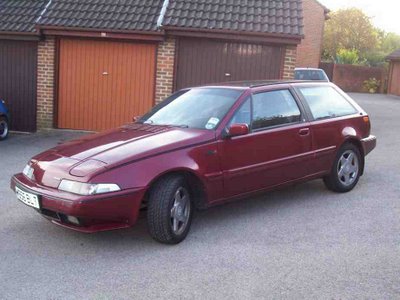
Sunday, September 24, 2006
Blogging as Journalism
 I just read a very interesting article in Writer's News about blogging.
Is blogging the new journalism?
Like it or not, the internet has transformed the writing industry, and perhaps not as you'd think. Book sales are as strong as ever. It seems nothing can match the experience of paper and ink in your hand (especially if it's by the beach, with some kind of rum drink in a hollowed out coconut.)
But journalism is changed forever.
Because now anybody and everybody has a voice. Whatever your opinion, sites like blogger allow you to create your own 'column.' A good showing online can lead to greater things. I'm sure you've all heard of Belle du Jour. She was a supposed Call Girl from London who posted her adventures on line. Recently, due to the number of hits and media attention her blog was getting, she managed to get a very juicy book deal. Belle du Jour's journal can now be found in Waterstones next to Winnie the Pooh.
Well, maybe not RIGHT NEXT to Pooh, but you get the picture.
They say that the blogger revolution will mean everybody will be famous for "fifteen people" instead of fifteen minutes. But other people might be able to follow Belle du Jour's example and make the leap from blogging to writing. Properly. And getting paid for it.
It's inspired me to think a bit more about what I post on my blog. I'm going to try and lean more towards interviews and opinions and lean away from shiny pictures of my new car. Maybe then I'll get discovered by an agent who wants an online journal like Belle Du Jour "but without the Jewish prostitute bits..."
I can wish, can't I?
Saturday, September 23, 2006
It's Red. It has Pop Up Headlights. Have we been here before?
Well, Bebop the Renault it no more, so for a couple of days I was left using what in Britain is laughingly referred to as "Public Transport." The trip to and from work cost almost £30 a day and I didn't get home until 20h30 one night!
Tina and I spent this weekend looking for a new 'ride.'
Ironically, we found her in the next door parking space. In fact, actually IN our parking space more often then not. Our neighbour has an impressive collection of cars (three Volvos and two Minis) and Tina was inspired enough to ask if he had any for sale.
Behold a maroon red Volvo 480.
When I was a kid, I remember my father having a turbo edition of this same car and telling me how he once got up to 120mph in it. When I discovered The Saint I always wondered if an eighties version of Simon Templar would drive Volvo's only 'sports' car since the P1800.
And it was red and had pop-up headlights.
So we bought it.
Tina and I spent this weekend looking for a new 'ride.'
Ironically, we found her in the next door parking space. In fact, actually IN our parking space more often then not. Our neighbour has an impressive collection of cars (three Volvos and two Minis) and Tina was inspired enough to ask if he had any for sale.
Behold a maroon red Volvo 480.
When I was a kid, I remember my father having a turbo edition of this same car and telling me how he once got up to 120mph in it. When I discovered The Saint I always wondered if an eighties version of Simon Templar would drive Volvo's only 'sports' car since the P1800.
And it was red and had pop-up headlights.
So we bought it.
Friday, September 22, 2006
Being Ginger
NB: Since writing this, I have blogged about being Ginger a few more times: http://rolandhulme.blogspot.com/2007/01/prejudice-against-gingers-daily-echo.html
http://rolandhulme.blogspot.com/2006/12/southpark-ginger-kids.html
http://rolandhulme.blogspot.com/2006/12/prejudice-against-redheads-ginger-is.html
 I stumbled across a VERY interesting post on blogger, from a lady called Forever Amber. It's about the terrible disfigurement she suffers. Being ginger.
Okay, Amber. You might be ginger, but in case you haven't looked in a mirror lately, you're also disgustingly attractive.
Anyway. Her post got me thinking about something I think about a lot.
Being Ginger in Britain is a miserable thing. I spent my childhood getting picked on and being called names merely because I had ginger hair - quite commonly by teachers as much as fellow pupils. At University I had a girlfriend who told her parents that her new boyfriend had 'light auburn brown' hair because she was ashamed of going out with a ginger (you know who you are!!) In pubs and clubs, I got cat calls for being ginger or looking like Chris Evans (one of the reasons I got contact lenses.)
It's not as bad these days, since I lost the glasses and put on a bit of weight. But I'll still slyly turn around when I hear people laughing in the street in case - just in case - they're laughing at me. Since I moved back to England, they never have. But the doubt's still there in the back of my mind. Things like this don't help. Ginger Kids.
I know that sounds ridiculous, but it's the way it is. It was one of the major reasons I left England in the first place. In France or America, I never ONCE got picked on for the colour of my hair. In fact, the French found it unique. In America, the most offensive nickname I picked up was "Red."
I loved living abroad. It was like, after being so self concious for such a long time, I'd suddenly become invisible. Even now, I'll feel more tranquil and alone sitting at a busy cafe in Paris than I ever could in the UK.
I just don't understand what the British mentality is about ginger hair. It's the only minority you're still legitimately allowed to pick on. The ginger characters are always portrayed as gormless, social pariahs on television. No newspaper can print an article about Chris Evans, Robin Cook or Mick Hucknall without using the term "ginger" in a derogatory way.
In Amber's article, she takes a verbatim chunk of dialogue from an online forum and changes to the word "ginger" to the word "black."
It's quite shocking.
In this day and age, if you got into a fight with somebody from a different enthnic background to you and you yelled out some reference to it, you'd be banged up with a 'hate crime.'
Why aren't attacks on people with ginger hair treated the same way?
People from an African background have black skin and curly black hair because of their genetic ancestry. I have red hair, pale skin and freckles because I have Scottish roots. It's all genetics. I am a product of my racial heritage as much as any black or asian person. So how come people like myself aren't protected from hate crimes in the same way?
It all stems down to the same reasons. Ginger haired people are the only minority you can still legitimately harass. No civilised person would hassle a black guy just because of the colour of his skin. But those same people, so desperate not to be accused of being 'racist,' would spill my pint in a pub and call me "copper knob."
I hate it. It's permanantly put my back up living in England. And while I've had very little trouble since moving to Winchester (which is, after all, a highly civilised place to live) I will still always feel slightly uneasy living here.
I think that's one of the reasons I made Adventure Eddy ginger.
It wasn't so he could duff up the people who picked on him, or come up with witty retorts when he was insulted in a pub. I didn't want to make him a 'Mary Sue' character who managed to accomplish all the things that I'd failed to when I was put in situations like that.
I just wanted to write about it so people knew it happened.
The irony is, of course, that the section of Adventure Eddy in which he gets picked on for being ginger was one of the first sections I deleted when I started trimming the story down to a managable size.
http://rolandhulme.blogspot.com/2006/12/southpark-ginger-kids.html
http://rolandhulme.blogspot.com/2006/12/prejudice-against-redheads-ginger-is.html
 I stumbled across a VERY interesting post on blogger, from a lady called Forever Amber. It's about the terrible disfigurement she suffers. Being ginger.
Okay, Amber. You might be ginger, but in case you haven't looked in a mirror lately, you're also disgustingly attractive.
Anyway. Her post got me thinking about something I think about a lot.
Being Ginger in Britain is a miserable thing. I spent my childhood getting picked on and being called names merely because I had ginger hair - quite commonly by teachers as much as fellow pupils. At University I had a girlfriend who told her parents that her new boyfriend had 'light auburn brown' hair because she was ashamed of going out with a ginger (you know who you are!!) In pubs and clubs, I got cat calls for being ginger or looking like Chris Evans (one of the reasons I got contact lenses.)
It's not as bad these days, since I lost the glasses and put on a bit of weight. But I'll still slyly turn around when I hear people laughing in the street in case - just in case - they're laughing at me. Since I moved back to England, they never have. But the doubt's still there in the back of my mind. Things like this don't help. Ginger Kids.
I know that sounds ridiculous, but it's the way it is. It was one of the major reasons I left England in the first place. In France or America, I never ONCE got picked on for the colour of my hair. In fact, the French found it unique. In America, the most offensive nickname I picked up was "Red."
I loved living abroad. It was like, after being so self concious for such a long time, I'd suddenly become invisible. Even now, I'll feel more tranquil and alone sitting at a busy cafe in Paris than I ever could in the UK.
I just don't understand what the British mentality is about ginger hair. It's the only minority you're still legitimately allowed to pick on. The ginger characters are always portrayed as gormless, social pariahs on television. No newspaper can print an article about Chris Evans, Robin Cook or Mick Hucknall without using the term "ginger" in a derogatory way.
In Amber's article, she takes a verbatim chunk of dialogue from an online forum and changes to the word "ginger" to the word "black."
It's quite shocking.
In this day and age, if you got into a fight with somebody from a different enthnic background to you and you yelled out some reference to it, you'd be banged up with a 'hate crime.'
Why aren't attacks on people with ginger hair treated the same way?
People from an African background have black skin and curly black hair because of their genetic ancestry. I have red hair, pale skin and freckles because I have Scottish roots. It's all genetics. I am a product of my racial heritage as much as any black or asian person. So how come people like myself aren't protected from hate crimes in the same way?
It all stems down to the same reasons. Ginger haired people are the only minority you can still legitimately harass. No civilised person would hassle a black guy just because of the colour of his skin. But those same people, so desperate not to be accused of being 'racist,' would spill my pint in a pub and call me "copper knob."
I hate it. It's permanantly put my back up living in England. And while I've had very little trouble since moving to Winchester (which is, after all, a highly civilised place to live) I will still always feel slightly uneasy living here.
I think that's one of the reasons I made Adventure Eddy ginger.

It wasn't so he could duff up the people who picked on him, or come up with witty retorts when he was insulted in a pub. I didn't want to make him a 'Mary Sue' character who managed to accomplish all the things that I'd failed to when I was put in situations like that.
I just wanted to write about it so people knew it happened.
The irony is, of course, that the section of Adventure Eddy in which he gets picked on for being ginger was one of the first sections I deleted when I started trimming the story down to a managable size.
Thursday, September 21, 2006
Helas! Mon pauvre Bebop, elle est mort!
Radiator. Head gasket. Roly's roadside repairs.
One of the above, or maybe all of them, contributed to the death of this lovable and reliable little car.
One of the above, or maybe all of them, contributed to the death of this lovable and reliable little car.
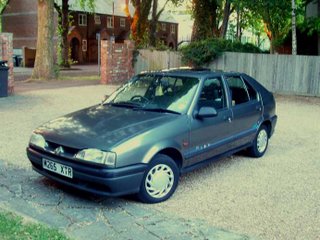
I will admit, she'd been slowly sliding from "reliable driver" to "clapped out banger" over the last couple of weeks, but she'd taken us across France happily enough and have been clocking up the miles over the last few weeks.
Yesterday, on the M27 on the way to Brighton, she gave up the ghost. Some roadside surgery was attempted, but I can honestly say it's never worked in the past, so I wasn't surprised when she failed to spring back into life merely because I'd refilled the radiator and looked at the dip stick.
You'll be missed, Bebop.
Tuesday, September 19, 2006
Fiona Walker: The Event Author
There are certain "event" authors.
These are the writers whose latest book release rates as an household event.
From the moment their coveted new hardback lands on the coffee table, it's devoured by eager readers. Leave that book unattended for more than a second and you'll risk coming back to find somebody else clutching it.
Traditionally, it's been Wilbur Smith and Jilly Cooper who've rated as the 'event' authors in the Hulme household. For the last few years though, author Fiona Walker's joined them.
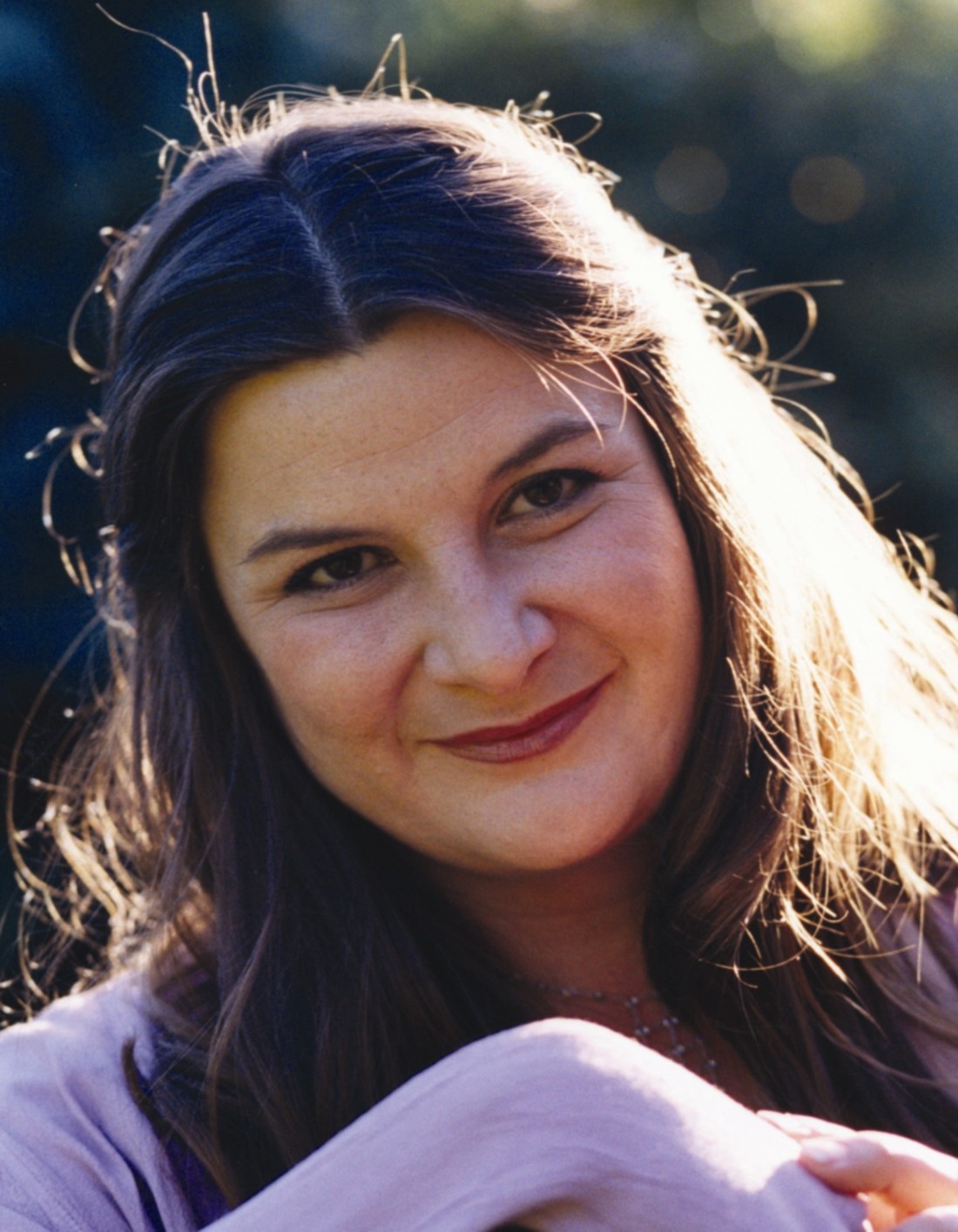
Now, I don't want to sound too sycophantic, but I adore Fiona Walker's books - quite a confession from a bloke, since she's hailed as the inventor of the 'chick-lit' genre. I think they're great. Hilariously funny, romantic and escapist, Fiona's got a brilliant turn of phrase and it's always been tough to put down one of her novels.
I've just finished Fiona's latest book, Tongue in Cheek, and loved every minute of it. It's a fast paced mystery in which Fiona introduces us to an enormous cast of characters. She's done it very skillfully, too, without leaving the reader constantly flicking to the front of the book wondering "who's this again?"
I've tried to emulate certain qualities of Fiona's writing in my own - especially the blistering dialogue and the colourful characters. She might seem an odd inspiration for the author of gratuitiously old fashioned adventure stories like mine, but I think Fiona's got a modern flair that my other writing influences lack and, like my favourite author, Leslie Charteris, it's obvious that Fiona has enormous fun writing her stories.
After publishing my interview with Robyn Young, I sent Fiona Walker a cheeky email to ask if she'd be willing to answer a few questions about how she went about the writing process. She agreed! Many thanks to Fiona for agreeing to this and I hope you find her answers as fascinating as I did.
My questions are in bold. Her answers are in italic. If you haven't gathered that by now, you're probably the person they're forced to print instructions on toothpicks for.
How did you get into writing? What inspired you to write your first book and why did you pick that particular genre?
I wrote French Relations initially as an exercise in occupational therapy – and then because it became an obsession, only finally suggesting itself as a potential career path.
I was laid low with a kidney infection, and signed off work for six weeks – longing for something entertaining to read. In the end, despairing of finding quite the right escapist fix, I started to write it myself. This was 1990, before ‘Chick Lit’ ever existed, more an era of bonk-busters and Aga Sagas. I adored anything funny – Jilly Cooper being a huge favourite - but also really wanted something that related to my own life, with a heroine that wasn’t a high-flyer, and a hero who laughed and talked her into love rather than throwing her on a silk-sheeted four-poster in a series of acrobatic sexual manoeuvres. Hence Tash French was born – the idea of the family gathering inspired by one of my own Rabelaisian kin’s summer parties.
Ultimately, when I was well enough to go back to work full-time, I found I was so hooked by writing this story that I gave up my rather stressful job in advertising and took a year out to finish the book, funding myself with part-time work (and very sympathetic parents). It didn’t really occur to me that it might be commercially publishable until I had almost finished and friends and family put me under increasing pressure to take the gamble and send it out to agents. Amazingly (to me, at least), two agents immediately wanted to sign me up. I guess my ‘genre’ (which was more luck than design) matched a change in direction for women’s fiction at that time, which ultimately resulted in what became known as ‘chick lit’. Then, as now, I simply wrote what I wanted to read, keeping plots and characters fairly close to my own life experience, with lashes of wish fulfilment in there too.
Your books are well known for having a complex cast of characters who pop up across books, like Odette, Pheobe, Juno and co. How did you come up with these characters and was there any particular reason why you decided to circulate your stories amongst a particular group of friends?
My female lead characters (and most of the supporting cast) always start life loosely based on my own friends. I like to think of them as all having a back-story, a life before the plot begins in Chapter One – even if it doesn’t get much air-time in the book itself – and equally I like to think of them continuing on after the final scene, hence it’s good to link books together via groups of friends. Equally, I might write a minor character in one book that interests me enough to want to expand into a more major character, or even a central heroine, in a following book. Again, linking the books together via friendships, or an area (such as the Lodes Valley) enables this.
Likewise, the Cotswold village you've created, Oddlode, seems to have a lot of stories to tell. What inspired you to create the place and what plans do you have for all the inhabitants?
This is partly laziness – I live in the Cotswolds, overlooking the real-life Evenlode Valley, so I don’t have to travel far to research! And I love the area – and its inhabitants – with a passion, making writing about them very easy. Being a chatty soul, I find that ideas are easy to come by – villagers love to gossip – and now that I am quite well-known locally as a writer, I get boundless suggestions from all sorts of sources. I could probably write about Oddlode for many years to come, but aim to write just two more novels in this series so that I can move on before the idea becomes too jaded. Ultimately, there is at least one character who I definitely plan to match up in dramatic fashion before I leave them alone, and a few more who might well get a few just desserts.
How do you go about putting a book together? Something like Tongue in Cheek is quite complex. Do you plan your stories out before hand?
I usually start with two or three fairly well-thought-out characters and a central plot idea. Then I’ll write a few thousand words just off-spec – travelling hopefully and going with the flow to see what happens. From this, I take time out to form a detailed plot and chapter plan from which to work on. Often, those first few thousand words are barely recognisable by the time the book is published, if they appear at all, but they get me going and free up my mind enough to know which direction to take. By the same token, the chapter plan is continually updated and tweaked as new ideas occur to me, or the book changes direction slightly, but on the whole I try to stay loyal to it because the plots are very complicated and it’s easy to lose direction totally.
How do you actually go about writing? Do you have an office or a study? Or an enormous kitchen table in front of an Aga? Do you choose to write in the morning or evening? Do you drink endless cups of coffee?
Over the years, I have written in all sort of different spots – I started in my sister’s old bedroom at my parents’ house on an ancient BBC computer, graduated to a laptop at the dining table in my own tiny London flat, then a proper desk in a larger flat, onto an old kitchen table in the attic of a Cotswold cottage and next to a tiny, cold lean-to study in my current house. A couple of years ago, I forked out for an extension and had a purpose-built study built with a great view across the valley and a wall of shelves which I have already overloaded with reference books and my own foreign editions (ego-tripping!). I find if I am truly in the grip of a book, I can write anywhere at any time (rather like reading), but when I get to the sticky bits or have a confidence crisis, it certainly helps to have a good spot in which to write, plus plenty of caffeine/wine. I have recently quit smoking, which is no doubt wonderful for my health, but murder when I need a displacement activity at my desk. On the whole, I write much better in the evenings, and even through the night when on a real ‘roll’. I like the silence and the solitude, plus the fact there is nothing to gaze at through the window except darkness. When dawn breaks, I know it’s time to call it a day – literally!
When you've finished your first draft, how do you go about the editing process? How different are your first drafts from the final versions we buy in Waterstones?
As an adrenaline junkie, I am usually horribly behind deadline and don’t have as much time as I’d like to edit. I print out a hard copy and hawk it round with me everywhere (in bed, on trains, on the sofa), covering it in red pen marks. I then type in these corrections, cursing myself when I get to a chapter that I have simply crossed out and written ‘rewrite all of this, only better!’ in red ink. If possible, I try to go through this process a couple of times before the manuscript goes to my editor, who equally covers it in (far politer) red pen marks. After a final bit of rewriting, it goes to be copy-edited and into production – then there’s really no going back. From first draft to published article, there will be some completely unrecognisable sections, but the bulk remains much the same.
Who are your favourite authors? What books do you particually like?
I am an avid reader and completely fickle. Although I try to keep up with my genre – particularly friends who write similar books – I am as likely to be caught devouring something historical or a biography. For true feel-good satisfaction, I still can’t find better than a really gripping modern family saga, laced with honesty and humour and hopefully a good romance at its heart. I just love Maeve Binchey, Katie Fforde, Lisa Jewell etc. For laughs, I adore Sophie Kinsella, Helen Fielding, Chris Manby, Jenny Colgan and others too numerous to mention. For tears, JoJo Moyes is a favourite – and, of course, I am still an avid Jilly Cooper fan, the fairy god-mother to us all.
What advice do you have for aspiring writers?
The first bit of advice I always give is to simply get on with it, trying not to analyse what you’re doing to much – write, write, write to get the book written. Just completing a novel is a huge task and a wonderful achievement, and it won’t happen unless you sit down and do it! Of course, reading also helps enormously – for inspiration, technique and to keep your imagination active (a writer must suspend his or her own disbelief in order to achieve the same for a reader). Be wary of trying too hard to write specifically to a commercial formula – aiming at one genre. Publishing is always evolving and what is in the shops today may not be what is selling by the time your own book is finished and published (a process that can take years). Much better to write something that you are passionate about, a story that really stays in the mind, characters that come alive, all set amid a backdrop that is convincing and real. And never be afraid to go back and change things quite radically. I personally prefer to have a finished novel that I am always editing than to have fifty different versions of Chapter One.
Thanks so much, Fiona. I'm incredibly excited to get a peek into how you go about writing!
Needless to say, you can pick up Tongue in Cheek and Fiona Walker's other books from most good bookshops or online at Amazon.
These are the writers whose latest book release rates as an household event.
From the moment their coveted new hardback lands on the coffee table, it's devoured by eager readers. Leave that book unattended for more than a second and you'll risk coming back to find somebody else clutching it.
Traditionally, it's been Wilbur Smith and Jilly Cooper who've rated as the 'event' authors in the Hulme household. For the last few years though, author Fiona Walker's joined them.
Now, I don't want to sound too sycophantic, but I adore Fiona Walker's books - quite a confession from a bloke, since she's hailed as the inventor of the 'chick-lit' genre. I think they're great. Hilariously funny, romantic and escapist, Fiona's got a brilliant turn of phrase and it's always been tough to put down one of her novels.
I've just finished Fiona's latest book, Tongue in Cheek, and loved every minute of it. It's a fast paced mystery in which Fiona introduces us to an enormous cast of characters. She's done it very skillfully, too, without leaving the reader constantly flicking to the front of the book wondering "who's this again?"
I've tried to emulate certain qualities of Fiona's writing in my own - especially the blistering dialogue and the colourful characters. She might seem an odd inspiration for the author of gratuitiously old fashioned adventure stories like mine, but I think Fiona's got a modern flair that my other writing influences lack and, like my favourite author, Leslie Charteris, it's obvious that Fiona has enormous fun writing her stories.
After publishing my interview with Robyn Young, I sent Fiona Walker a cheeky email to ask if she'd be willing to answer a few questions about how she went about the writing process. She agreed! Many thanks to Fiona for agreeing to this and I hope you find her answers as fascinating as I did.
My questions are in bold. Her answers are in italic. If you haven't gathered that by now, you're probably the person they're forced to print instructions on toothpicks for.
How did you get into writing? What inspired you to write your first book and why did you pick that particular genre?
I wrote French Relations initially as an exercise in occupational therapy – and then because it became an obsession, only finally suggesting itself as a potential career path.
I was laid low with a kidney infection, and signed off work for six weeks – longing for something entertaining to read. In the end, despairing of finding quite the right escapist fix, I started to write it myself. This was 1990, before ‘Chick Lit’ ever existed, more an era of bonk-busters and Aga Sagas. I adored anything funny – Jilly Cooper being a huge favourite - but also really wanted something that related to my own life, with a heroine that wasn’t a high-flyer, and a hero who laughed and talked her into love rather than throwing her on a silk-sheeted four-poster in a series of acrobatic sexual manoeuvres. Hence Tash French was born – the idea of the family gathering inspired by one of my own Rabelaisian kin’s summer parties.
Ultimately, when I was well enough to go back to work full-time, I found I was so hooked by writing this story that I gave up my rather stressful job in advertising and took a year out to finish the book, funding myself with part-time work (and very sympathetic parents). It didn’t really occur to me that it might be commercially publishable until I had almost finished and friends and family put me under increasing pressure to take the gamble and send it out to agents. Amazingly (to me, at least), two agents immediately wanted to sign me up. I guess my ‘genre’ (which was more luck than design) matched a change in direction for women’s fiction at that time, which ultimately resulted in what became known as ‘chick lit’. Then, as now, I simply wrote what I wanted to read, keeping plots and characters fairly close to my own life experience, with lashes of wish fulfilment in there too.
Your books are well known for having a complex cast of characters who pop up across books, like Odette, Pheobe, Juno and co. How did you come up with these characters and was there any particular reason why you decided to circulate your stories amongst a particular group of friends?
My female lead characters (and most of the supporting cast) always start life loosely based on my own friends. I like to think of them as all having a back-story, a life before the plot begins in Chapter One – even if it doesn’t get much air-time in the book itself – and equally I like to think of them continuing on after the final scene, hence it’s good to link books together via groups of friends. Equally, I might write a minor character in one book that interests me enough to want to expand into a more major character, or even a central heroine, in a following book. Again, linking the books together via friendships, or an area (such as the Lodes Valley) enables this.
Likewise, the Cotswold village you've created, Oddlode, seems to have a lot of stories to tell. What inspired you to create the place and what plans do you have for all the inhabitants?
This is partly laziness – I live in the Cotswolds, overlooking the real-life Evenlode Valley, so I don’t have to travel far to research! And I love the area – and its inhabitants – with a passion, making writing about them very easy. Being a chatty soul, I find that ideas are easy to come by – villagers love to gossip – and now that I am quite well-known locally as a writer, I get boundless suggestions from all sorts of sources. I could probably write about Oddlode for many years to come, but aim to write just two more novels in this series so that I can move on before the idea becomes too jaded. Ultimately, there is at least one character who I definitely plan to match up in dramatic fashion before I leave them alone, and a few more who might well get a few just desserts.
How do you go about putting a book together? Something like Tongue in Cheek is quite complex. Do you plan your stories out before hand?
I usually start with two or three fairly well-thought-out characters and a central plot idea. Then I’ll write a few thousand words just off-spec – travelling hopefully and going with the flow to see what happens. From this, I take time out to form a detailed plot and chapter plan from which to work on. Often, those first few thousand words are barely recognisable by the time the book is published, if they appear at all, but they get me going and free up my mind enough to know which direction to take. By the same token, the chapter plan is continually updated and tweaked as new ideas occur to me, or the book changes direction slightly, but on the whole I try to stay loyal to it because the plots are very complicated and it’s easy to lose direction totally.
How do you actually go about writing? Do you have an office or a study? Or an enormous kitchen table in front of an Aga? Do you choose to write in the morning or evening? Do you drink endless cups of coffee?
Over the years, I have written in all sort of different spots – I started in my sister’s old bedroom at my parents’ house on an ancient BBC computer, graduated to a laptop at the dining table in my own tiny London flat, then a proper desk in a larger flat, onto an old kitchen table in the attic of a Cotswold cottage and next to a tiny, cold lean-to study in my current house. A couple of years ago, I forked out for an extension and had a purpose-built study built with a great view across the valley and a wall of shelves which I have already overloaded with reference books and my own foreign editions (ego-tripping!). I find if I am truly in the grip of a book, I can write anywhere at any time (rather like reading), but when I get to the sticky bits or have a confidence crisis, it certainly helps to have a good spot in which to write, plus plenty of caffeine/wine. I have recently quit smoking, which is no doubt wonderful for my health, but murder when I need a displacement activity at my desk. On the whole, I write much better in the evenings, and even through the night when on a real ‘roll’. I like the silence and the solitude, plus the fact there is nothing to gaze at through the window except darkness. When dawn breaks, I know it’s time to call it a day – literally!
When you've finished your first draft, how do you go about the editing process? How different are your first drafts from the final versions we buy in Waterstones?
As an adrenaline junkie, I am usually horribly behind deadline and don’t have as much time as I’d like to edit. I print out a hard copy and hawk it round with me everywhere (in bed, on trains, on the sofa), covering it in red pen marks. I then type in these corrections, cursing myself when I get to a chapter that I have simply crossed out and written ‘rewrite all of this, only better!’ in red ink. If possible, I try to go through this process a couple of times before the manuscript goes to my editor, who equally covers it in (far politer) red pen marks. After a final bit of rewriting, it goes to be copy-edited and into production – then there’s really no going back. From first draft to published article, there will be some completely unrecognisable sections, but the bulk remains much the same.
Who are your favourite authors? What books do you particually like?
I am an avid reader and completely fickle. Although I try to keep up with my genre – particularly friends who write similar books – I am as likely to be caught devouring something historical or a biography. For true feel-good satisfaction, I still can’t find better than a really gripping modern family saga, laced with honesty and humour and hopefully a good romance at its heart. I just love Maeve Binchey, Katie Fforde, Lisa Jewell etc. For laughs, I adore Sophie Kinsella, Helen Fielding, Chris Manby, Jenny Colgan and others too numerous to mention. For tears, JoJo Moyes is a favourite – and, of course, I am still an avid Jilly Cooper fan, the fairy god-mother to us all.
What advice do you have for aspiring writers?
The first bit of advice I always give is to simply get on with it, trying not to analyse what you’re doing to much – write, write, write to get the book written. Just completing a novel is a huge task and a wonderful achievement, and it won’t happen unless you sit down and do it! Of course, reading also helps enormously – for inspiration, technique and to keep your imagination active (a writer must suspend his or her own disbelief in order to achieve the same for a reader). Be wary of trying too hard to write specifically to a commercial formula – aiming at one genre. Publishing is always evolving and what is in the shops today may not be what is selling by the time your own book is finished and published (a process that can take years). Much better to write something that you are passionate about, a story that really stays in the mind, characters that come alive, all set amid a backdrop that is convincing and real. And never be afraid to go back and change things quite radically. I personally prefer to have a finished novel that I am always editing than to have fifty different versions of Chapter One.
Thanks so much, Fiona. I'm incredibly excited to get a peek into how you go about writing!
Needless to say, you can pick up Tongue in Cheek and Fiona Walker's other books from most good bookshops or online at Amazon.
Sunday, September 17, 2006
This Writing Life: A Writer's Life

A brilliant post on how author Ian Hocking got his book published, and how he's working on putting the next two into publishable form.
This Writing Life: A Writer's Life
Not as funny as Days of Thunder, but a hell of a lot more realistic...
We've just seen the new Will Ferrell movie, Talledega Nights: The Ballad of Ricky Bobby. And Ferrell's midas touch continues.
It's the hilarious story of racing driver Ricky Bobby, who hits the NASCAR circuit with one simple philosophy. If you're not first, you're last.
It's the hilarious story of racing driver Ricky Bobby, who hits the NASCAR circuit with one simple philosophy. If you're not first, you're last.
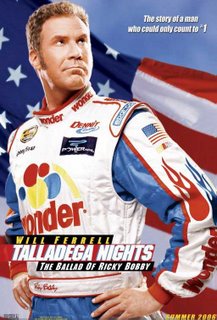
Success follows success, until his racing team hires homosexual formula one driver Jean Girard (Sacha Baron Cohen, TV's Ali G) as his teammate.
Talledega Nights take a swipe at middle America (Will Ferrell's characterisation of Ricky Bobby is eerily close to his impressions of George Dubya Bush) and the sponsor-driven world of professional American sports racing (in one scene, Rick Bobby's family sit down to say a version of Grace sponsored by Powerade.)

What's more, the film is hilarious throughout. I was gripping the sides of my seat as one joke followed another, each hitting the funny bone with dangerous accuracy.
Saturday, September 16, 2006
Outraged Muslim Community Burn American Flags!
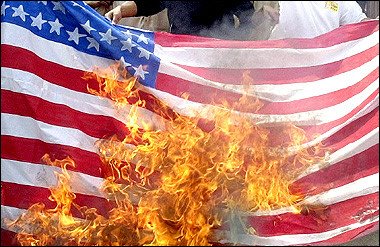
Is it that time of the week again already?
NEXT TIME: Roly asks: Is there some kind of fireproof flag we could invent?
Wednesday, September 13, 2006
New Day, New Book
I've decided to lay off the Eddy for a bit. I've really got to concentrate on getting Adventure Eddy published, rather than working on the sequel, The Bootleg Boys. That's the story in which Eddy comes back to England and then ties into what I've written before - Rules of Engagement (a poisoner tries to disrupt Eddy's sister's wedding) Black Dog (Eddy battles a legendary Dartmoor werewolf) Silver Relic (Eddy goes to Germany to track down some blueprints) and Science Lesson (somebody's trying to murder Eddy.)
I have decided to work on a new book. The VERY exciting 'Radio Advertising for the Small Business.'
I have decided to work on a new book. The VERY exciting 'Radio Advertising for the Small Business.'

Basically, it's a guide to how small, local businesses can find a cost effective way to advertise on radio. It explains away all the jargon and shows how radio advertising works. I'm hopefully getting some really great radio experts to contribute (like my old bosses Gordon Drummond and Carolyn Hayward.)
I will keep you updated. If you know any small businesses that want to increase their business, tell them about my (unwritten) book!
Friday, September 08, 2006
Eddy on Demand
To give Lulu a try, I recently published two books there. One was my own Adventure Eddy story (which you can read in it's unedited less-than-glory here.) Then there was one of my mother's stories, A Long Way West, which she wrote a few years ago.
It took about ten days for them to arrive and they both looked fab.
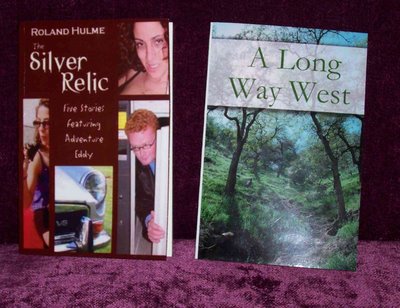
It took about ten days for them to arrive and they both looked fab.
They were printed in two different styles. Adventure Eddy was printed in classic American format, with a 6"x9" layout and beige paper. Mum's was printed in British 6.14" x 9.21" format with white paper. Mum's looked a lot better, I have to admit.
Her book looked like this:
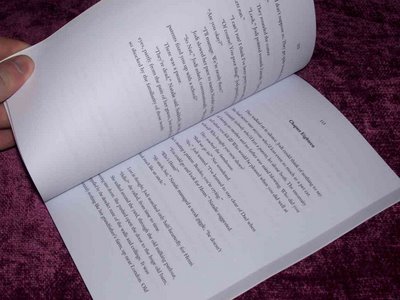
My book, on the other hand, turned out a bit 'busier' and had that old 'pulp fiction' kind of feel to it with the slightly yellow paper. Although 'pulp fiction' is probably quite a good description.
It looked like this:
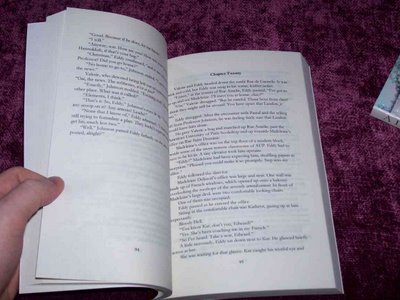
Because I'd pressed the wrong buttons, my name came out on the spine of Adventure Eddy, but Mother was left anonymous.
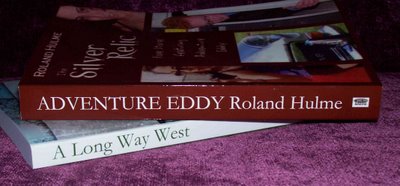
In the end, including postage, each book cost about a tenner, which wasn't that bad.
The thing that amazed me was just how good they looked. I mean, here I was, holding a real book in my hand. It was amazing.
How is it done?
Thought I'd write just a little about the whole process of uploading and publishing with Lulu.
First off, you need to register for a free account. That's fairly simple. Then you have to 'Start a Project.' I started off with Mum's book.
They ask you if you want to make the book available to the public or just have it available to yourself. This is so you can simply use Lulu as a printing service (like I did) or actually as the hub of your publishing empire. If you choose to make your book available to the public, you are given your own page on Lulu to promote your book. For a small fee, you can also buy an ISBN number which will then be tied in with Amazon and other online book sellers. It also means places like Waterstones can actually order your book.
They won't, by the way. But in theory they could. Although you could still walk into Waterstones and say "I'd like a copy of this" and then they'd send off for it (knowing that somebody will buy it.)
I chose to make both books available only to myself, because in that way they're not officially 'published' and I can still send both manuscripts around to real publishers.
Next, you have to upload the manuscript.
Like real publishers, Lulu work off Adobe PDF files. Fortunately, they have the facility to convert your Microsoft Word and Works files into PDF's. What you have to do, though, is make sure your document is formatted correctly.
This goes beyond just checking the spelling. You are responsible for everything that appears between the covers of your book. The title page. The publisher info. The contents. Even the page numbers. I spent a lot of time poking about before I got things looking right, but if even a computer dyslexic like me can do it, anybody can. The finished article was indistinguishable from a book you'd pick up in WH Smiths.
Then, you have to pick how you want your book to appear. This includes the size of the book to the way it's printed. You can publish paperbacks or hardbacks, full colour or black and white. You can even decide what colour paper you want them printed on.
Lastly, you need to pick the covers.
This is the fun bit. With Mum's book, I picked a 'library' picture, which was a standard Lulu royalty-free picture. The title of the book (but sadly not Mum's name) was printed on the cover and the spine.
On my book, I uploaded my own cover. I didn't have one for Adventure Eddy and wasn't feeling very creative, so I uploaded a cover I'd designed a few years ago for "The Silver Relic." It looks a bit cheesy, but shows off the possibilities.
If you want, you can make your own 'one peice' cover instead of having seperate back-and-front covers and a generic spine. This is slightly more complicated through and you'll need to convert it into a PDF yourself. I wasn't brave enough for that!
Once you've decided all of that, you're good to go. Click on the publish button and you're done.
You have to 'buy' your own copy (and you can even earn yourself royalties from your own purchase) but ten days later, you'll receive a lovely copy of your book.
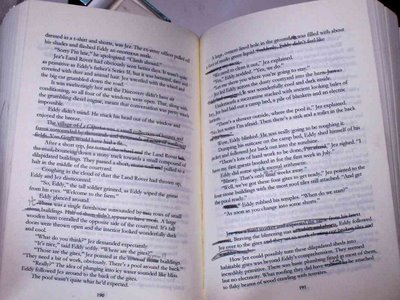
I was very impressed with what Lulu produced. Mum's book got sent off to France as a bit of a suprise present (and hopefully inspiration to keep on writing.) My copy of Adventure Eddy, considering it had the wrong cover and was riddled with mistakes, has been adopted as my 'handheld touch-pad editing device.'
As in, I've got a pencil and started scribbling in it, trying to put together a final, edited version.
Thursday, September 07, 2006
Lulu - Not the annoying singer.
I read somewhere that there are two defining moments in a writer's life. The first, when they see their book in print. The second, when people actually go out and buy that book.

That first defining moment is easier than ever to accomplish, thanks to the wonders of modern technology. I stumbled across a website called Lulu.com, who offer a POD service. That means 'Print on Demand.'
Basically, you can upload your book and buy a perfectly bound copy of it, just like you'd pick up in Waterstones. What makes 'POD' different from paying somebody else to print your book is that you can print out just a single copy and it won't cost more than an equivilent book in WH Smiths. Printers generally expect orders of hundred or thousands of copies.
Lulu.com suggest that this service is going to revolutionize the publishing world. I'm not so sure about that, but it is a wonderful facility to have. They will print your books and mail them anywhere in the world. In addition, you can actually 'publish' your book on line and buy an official ISDN number (the international book code that allows book sellers to take orders for books.) With this service, you can put your book online and sell it via Lulu's website or tie it in with a real online bookseller like Amazon. When somebody orders it, a copy gets printed and mailed to the customer.
The advantages of POD are obvious. Printing books is expensive. If they don't sell, the printed books just end up festering in some warehouse (if books fester) or being piled up high and sold cheap at The Works. Unless a publisher sells the books they print, they lose money. Sometimes a lot of money. Dorling Kindersley printed 13 million copies of their pictorial guide to Star Wars: Episode One and only sold 3 million. The firm was sold soon afterwards.
With POD, copies of the book are only printed when they've been ordered. While the cost per unit might be higher than large scale printings, in means there's no wastage. It basically takes the risk out of publishing.
However, there are disadvantages.
The reason it's so tough to get your book published is because publishers have very high standards. They are only going to invest in products that will give them a return. In that respect, the books they publish need to be more than just well written and entertaining. They need to appeal to a market that will shell out money to buy them.
With POD, however, anybody can publish anything. There's no quality control. If you look on the Lulu website you'll see thousands and thousands of books being pushed on their online catalogue. Most of them are supposed to be awful.
Real publishers spend money on editing, fact checking and layout. Since Lulu leaves all of that to the individual author, many of the books you'll find on their catalogue are poorly edited and riddled with spelling mistakes. I should know. I've tried my hand at it myself. More on that later.
Lulu offers something wonderful. The chance for absolutely anybody to see their books in print. What they can't offer are the things that really make publishers worthwhile. The attention to detail and their immense marketing budgets.
Marketing is the big one. You can have the best book in the world, but unless people know about it, nobody will ever read it. Compare, for example, Dan Brown's Da Vinci Code against a best seller on the Lulu Catalogue. Da Vinci sold over 30 million copies. Lulu's 'best sellers' struggle to sell more than 500.
Which brings us on to the second defining moment in a writer's life. That moment when you find out about people - lots of people - going out to buy your book. Lulu say their philosophy is to turn around the old publishing system. Instead of one hundred authors selling a million books, they want a million authors to each sell 100 books. Is that a good or a bad thing?
While POD services like Lulu have made getting into print easier than ever, they're making it harder and harder to break into the big time. And, let's admit it. Secretly all aspiring writers want their books to become the next Da Vinci Code.
That first defining moment is easier than ever to accomplish, thanks to the wonders of modern technology. I stumbled across a website called Lulu.com, who offer a POD service. That means 'Print on Demand.'
Basically, you can upload your book and buy a perfectly bound copy of it, just like you'd pick up in Waterstones. What makes 'POD' different from paying somebody else to print your book is that you can print out just a single copy and it won't cost more than an equivilent book in WH Smiths. Printers generally expect orders of hundred or thousands of copies.
Lulu.com suggest that this service is going to revolutionize the publishing world. I'm not so sure about that, but it is a wonderful facility to have. They will print your books and mail them anywhere in the world. In addition, you can actually 'publish' your book on line and buy an official ISDN number (the international book code that allows book sellers to take orders for books.) With this service, you can put your book online and sell it via Lulu's website or tie it in with a real online bookseller like Amazon. When somebody orders it, a copy gets printed and mailed to the customer.
The advantages of POD are obvious. Printing books is expensive. If they don't sell, the printed books just end up festering in some warehouse (if books fester) or being piled up high and sold cheap at The Works. Unless a publisher sells the books they print, they lose money. Sometimes a lot of money. Dorling Kindersley printed 13 million copies of their pictorial guide to Star Wars: Episode One and only sold 3 million. The firm was sold soon afterwards.
With POD, copies of the book are only printed when they've been ordered. While the cost per unit might be higher than large scale printings, in means there's no wastage. It basically takes the risk out of publishing.
However, there are disadvantages.
The reason it's so tough to get your book published is because publishers have very high standards. They are only going to invest in products that will give them a return. In that respect, the books they publish need to be more than just well written and entertaining. They need to appeal to a market that will shell out money to buy them.
With POD, however, anybody can publish anything. There's no quality control. If you look on the Lulu website you'll see thousands and thousands of books being pushed on their online catalogue. Most of them are supposed to be awful.
Real publishers spend money on editing, fact checking and layout. Since Lulu leaves all of that to the individual author, many of the books you'll find on their catalogue are poorly edited and riddled with spelling mistakes. I should know. I've tried my hand at it myself. More on that later.
Lulu offers something wonderful. The chance for absolutely anybody to see their books in print. What they can't offer are the things that really make publishers worthwhile. The attention to detail and their immense marketing budgets.
Marketing is the big one. You can have the best book in the world, but unless people know about it, nobody will ever read it. Compare, for example, Dan Brown's Da Vinci Code against a best seller on the Lulu Catalogue. Da Vinci sold over 30 million copies. Lulu's 'best sellers' struggle to sell more than 500.
Which brings us on to the second defining moment in a writer's life. That moment when you find out about people - lots of people - going out to buy your book. Lulu say their philosophy is to turn around the old publishing system. Instead of one hundred authors selling a million books, they want a million authors to each sell 100 books. Is that a good or a bad thing?
While POD services like Lulu have made getting into print easier than ever, they're making it harder and harder to break into the big time. And, let's admit it. Secretly all aspiring writers want their books to become the next Da Vinci Code.
Wednesday, September 06, 2006
Robin Hood and his Merry Men who wear tights but are NOT GAY!
I'm sorry I haven't posted for a while. I've just spent the last few days in Nottingham, at Trent FM, finding out a bit more about how my wonderful script ideas get turned into brilliant commercials.

Nottingham is Robin Hood country and I peeked into the Robin Hood museum while I was there. They were unable to explain how Kevin Costner and Morgan Freeman, in Robin Hood: Prince of Thieves, managed to walk from the White Cliffs of Dover to Sherwood Forest in the space of a single day.
Nottingham is Robin Hood country and I peeked into the Robin Hood museum while I was there. They were unable to explain how Kevin Costner and Morgan Freeman, in Robin Hood: Prince of Thieves, managed to walk from the White Cliffs of Dover to Sherwood Forest in the space of a single day.
Subscribe to:
Posts (Atom)